
Bike tyre pressure calculator: the ultimate tool
For a long time we believed you had to pump your tyres up “as hard as possible” to go fast. It is a mistake in physics that costs you dearly, in comfort and in pure performance.
I still see it too often: riders pumping 28 mm tyres up to 8 bar because “that’s what we’ve always done”. Yet your tyre pressure governs the only point of contact between your power and the road. The wrong pressure is like driving a sports car with welded suspension: it’s harsh, it bounces, and it doesn’t go as fast as it should.
To help you stop guessing, I have developed this bike tyre pressure calculator. It doesn’t stop at your weight: it takes into account the actual width of your tyres, your setup (tubeless or inner tube) and even an often forgotten detail: the internal width of your rim.
Pressure calculator
*Recommended values for guidance only. Always respect the maximum pressure printed on the sidewall of your tyres.
Contents
Why I stopped following the “10% rule”
For decades, the rule of thumb in the peloton was to inflate to 10% of your weight (e.g. 7 bar for 70 kg). As equipment has evolved, this rule has become obsolete. Worse, it is counterproductive.
The physics has changed (and so have your tyres)
Today, we no longer ride 19 or 23 mm tyres. The standard has moved to 25 mm, 28 mm or even 30 mm on the road, and well beyond 40 mm on gravel.
The physics is simple: the wider a tyre is, the less pressure it needs to support the same load.
If I pump a 28 mm tyre up to 7 bar, I create a casing so stiff that it will bounce off every tiny imperfection in the tarmac instead of absorbing it. This is what is known as impedance losses. Instead of rolling over the road, you are hitting against its flaws.
Stan’s tip
On a coarse road surface, dropping your pressure by 1 bar can save you up to 5 to 10 watts of rolling resistance thanks to better vibration absorption. Comfort is not the enemy of speed, it is its ally.
Bike tyre pressure calculator: the details that refine my calculation
To understand the results the calculator gives you, we need to look at the variables I have built into the algorithm.
Total weight (rider + bike system)
Pressure is there above all to stop the rim hitting the ground (“bottoming out”). The relationship is not linear: if you weigh 100 kg, you should not run double the pressure of a 50 kg rider. I use a power curve to smooth these values and keep you safe.
Internal rim width: the experts’ secret
This is the parameter most basic calculators forget. Yet if you read my wheel reviews, you know it is crucial.
- A narrow rim (15-17 mm) “pinches” the tyre, giving it a light-bulb shape. You need more pressure to avoid lateral squirm.
- A modern wide rim (19 mm, 21 mm, or even 25 mm on gravel) opens the tyre out into a “U” shape. The actual air volume increases considerably.
The result: the wider your rim, the more I recommend lowering the pressure.
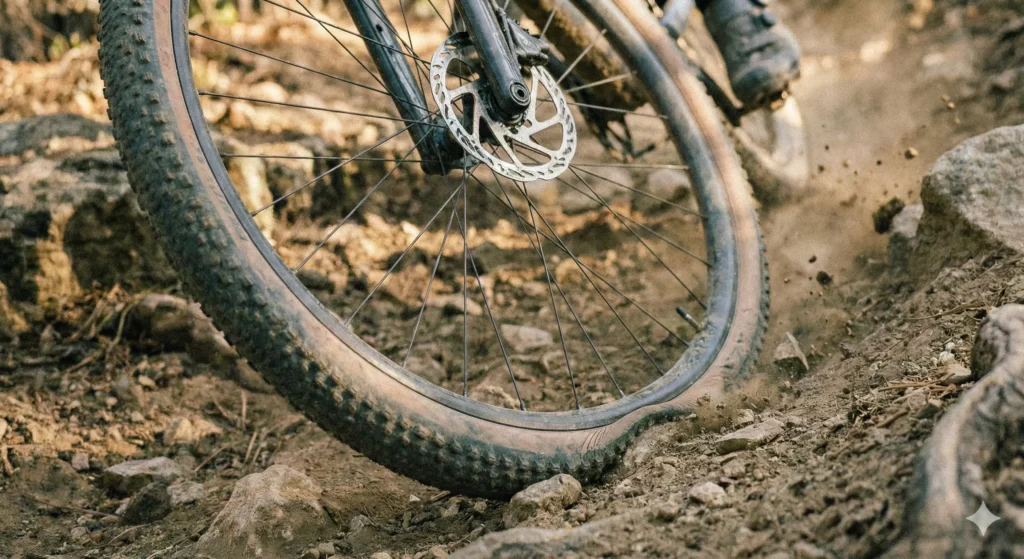 Air volume depends on the tyre and rim combination. A wide rim lets you run lower pressure.
Tubeless vs inner tube
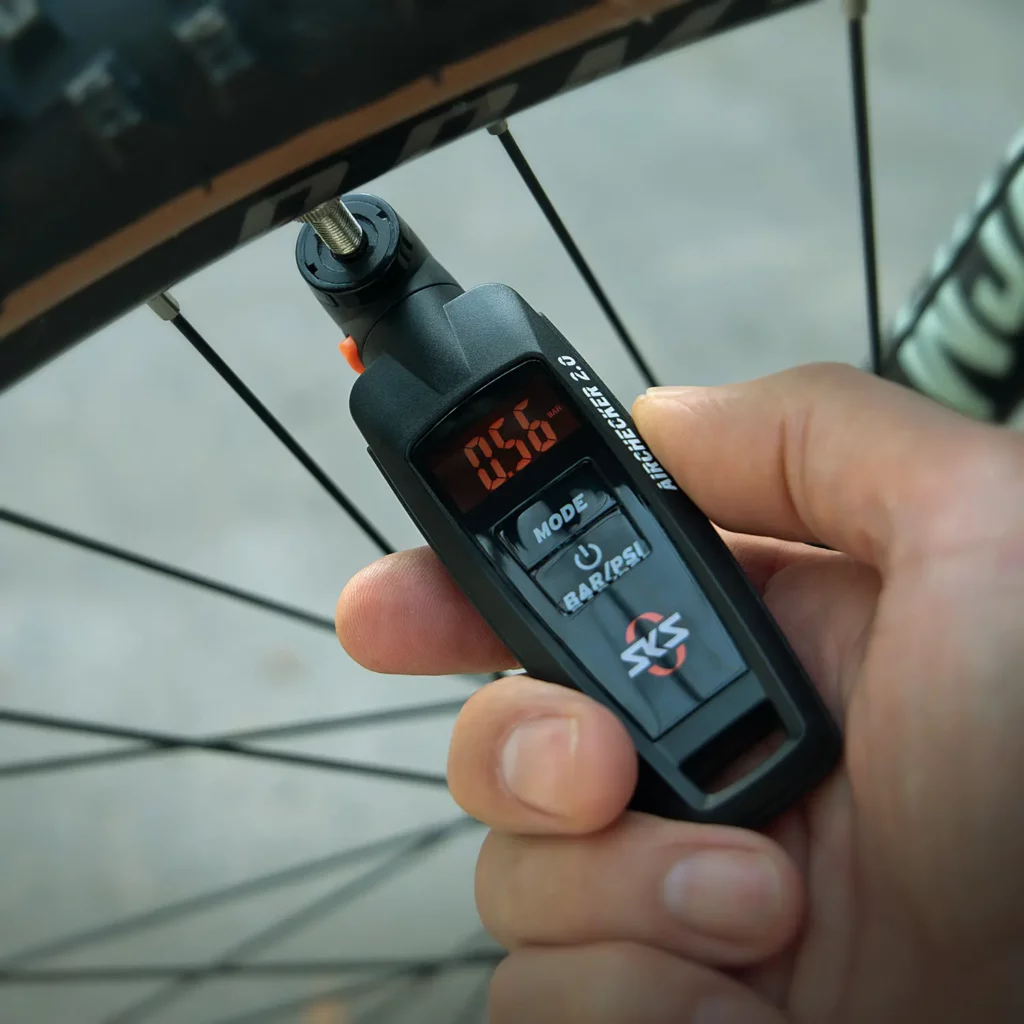
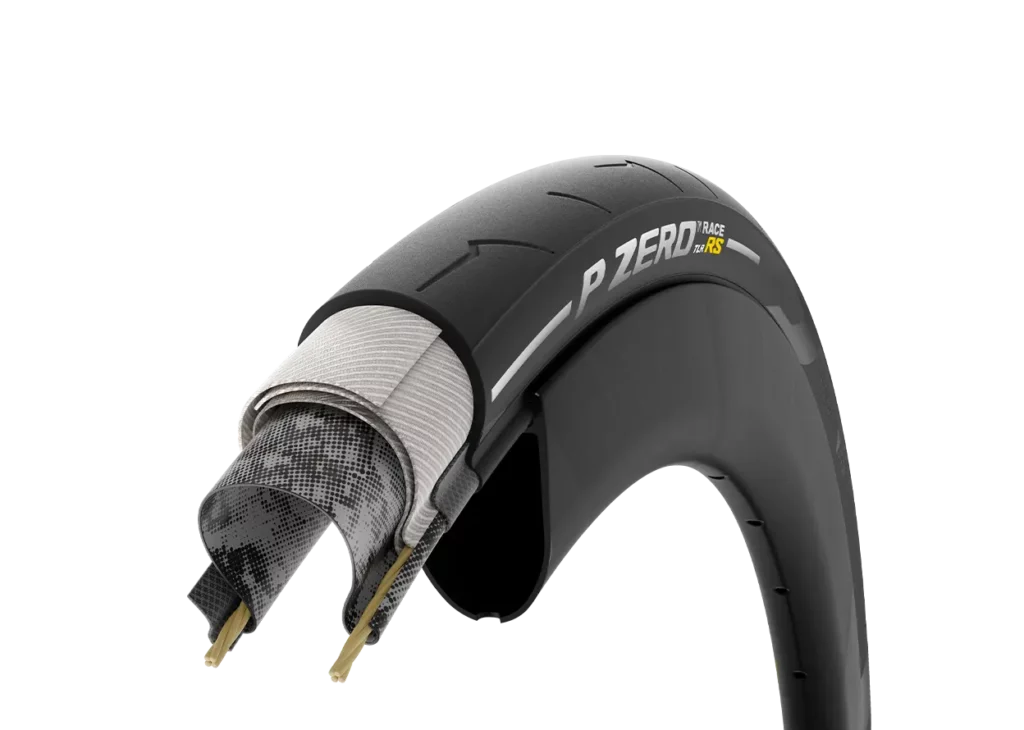
Tubeless is not just a puncture-protection technology. Without the friction between the inner tube and the tyre, the wheel is more supple (less hysteresis). In addition, with no risk of pinching the tube, you can reduce pressure by around 10 to 15%. That is where the real difference in cornering grip is made.
How to read your results
My tool gives you two values: front and rear. Why? Because the weight distribution on your bike is not 50/50. It is generally 40% at the front and 60% at the rear.
- Rear wheel: this is the driving, load-bearing wheel. It needs more pressure to protect the rim and ensure power transfer.
- Front wheel: this is the steering wheel. It needs less pressure to maximise grip in corners and filter out the shocks that travel up into your arms.
A note on the weather
If you select “rain” in the calculator, I automatically reduce the recommendation. On wet roads, we are not looking for pure efficiency, but to increase the contact area with the ground (the “contact patch”) to avoid sliding.
FAQ: your frequently asked questions
Conclusion
Pressure is not a fixed, magic number. It changes with your weight (if you are carrying a rucksack, for example), your equipment and the day’s terrain. Use this calculator as a solid starting point, then fine-tune by +/- 0.2 bar according to how it feels.
Not sure about your rim and tyre combination? Ask me your question in the comments with your exact setup, and I will help you find the right setting.
Leave a Reply