
Mavic Comète 45/55 and 55/65: the real Comète have arrived
Two Comète in four months. In May 2026, Mavic launched the Comète 50: 23mm internal rim width, 1315g, €2499. On 1 September 2026, the brand presented the Mavic Comète 45/55 and 55/65, with a 25mm rim matched to a 30mm tyre, 21 carbon spokes per wheel and ceramic bearings as standard. The Mavic Comète 45/55 weigh 1350g a pair, the 55/65 1390g, still for €2499. The range is completed by the Comète 85/85 and 85/Disc for time trials and triathlon. So why two generations so close together, and which is the real Comète? Let’s take them apart.
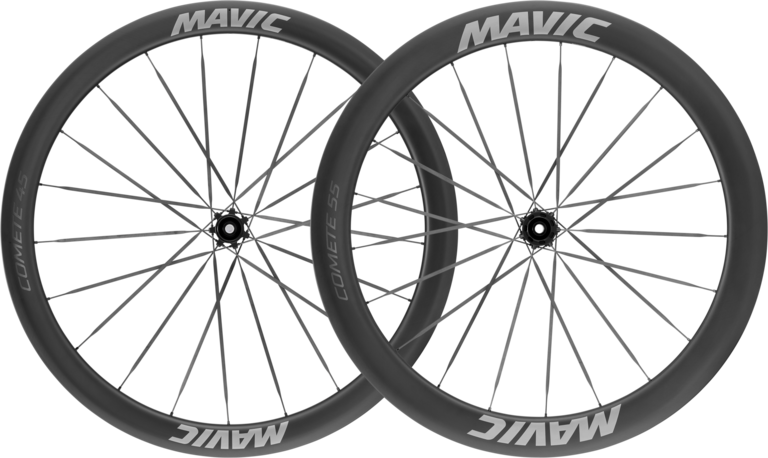
Comète 50 vs Comète 45/55: two wheels, two philosophies at Mavic
Back to May. The Comète 50 arrived with a spec sheet that ticked every box expected in the segment: 50mm rim depth, 23mm internal width for 30mm external width, 21 carbon spokes supplied by Vonoa, ceramic bearings, 1315g a pair (600g front, 715g rear), all wind-tunnel tested with 28mm tyres. Mavic then claimed 12 seconds saved over 50km against its own Cosmic SLR 45. Vonoa is also the spoke supplier for the Newmen Streem Vonoa, sold for €1690.
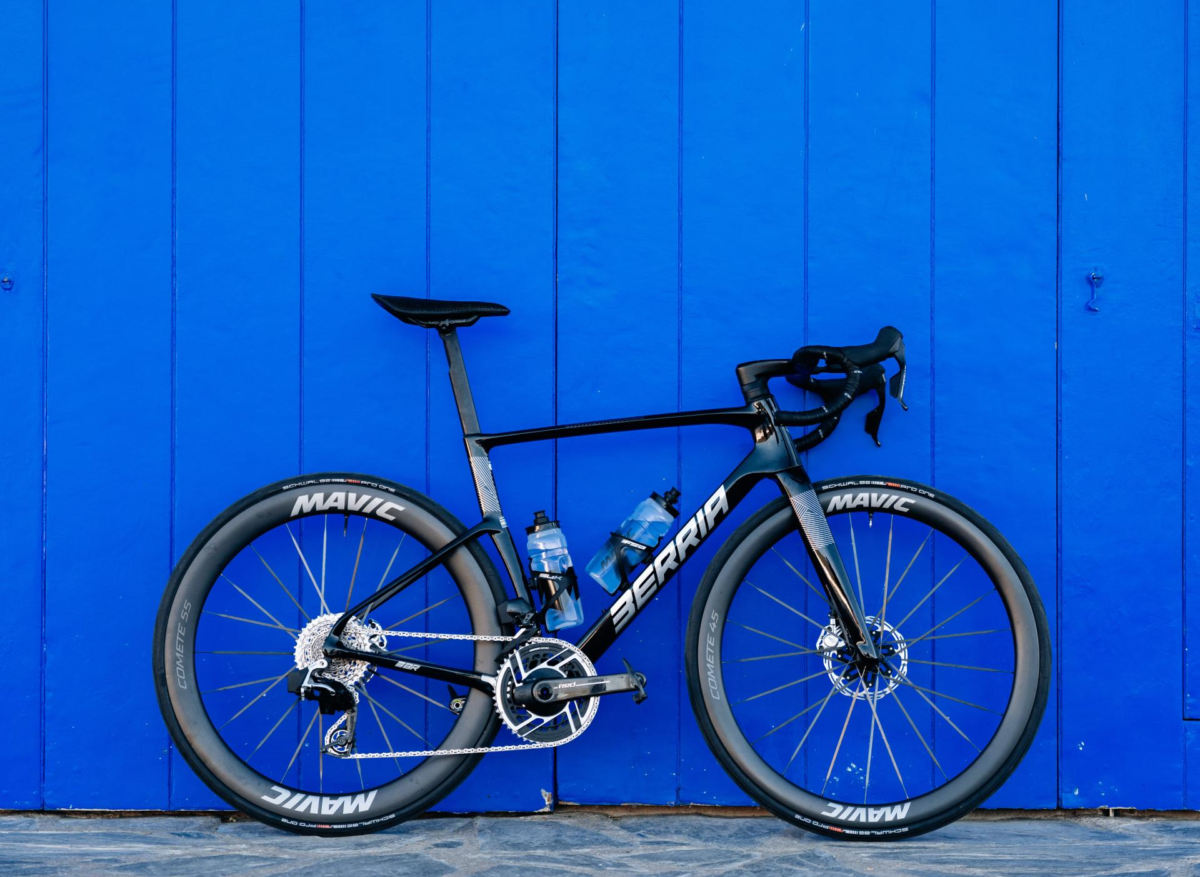
According to our information, the Comète 50 was rushed out in response to pressure from Newmen and Chinese carbon wheels. An off-the-shelf rim, a spec sheet matched to what the market demands, and little R&D behind it. It can now be found as original equipment at Berria and Look. The Comète 45/55 and 55/65 are the next step, the real one: Mavic’s own moulds, in-house technical choices and the switch to the 25mm rim. With this move to 25mm, Mavic is no longer content to follow the market: the brand wants to set the pace again.
One detail gives it away: a good part of the launch messaging is recycled from one Comète to the other. The 250 hours in the wind tunnel in Geneva, the 57 test protocols, the endurance equivalent to 700000km, the 18% less rotational drag on the spokes and the hubs lightened by 5g and 22g were already in the Comète 50 communication. What really changes on the 45/55 and 55/65 is the rim. Another point to note: at the same price, the Comète 50 remains lighter than the Comète 45/55 (1315g against 1350g).
Mavic Comète 45/55 and 55/65: a 25mm rim designed for the 30mm tyre
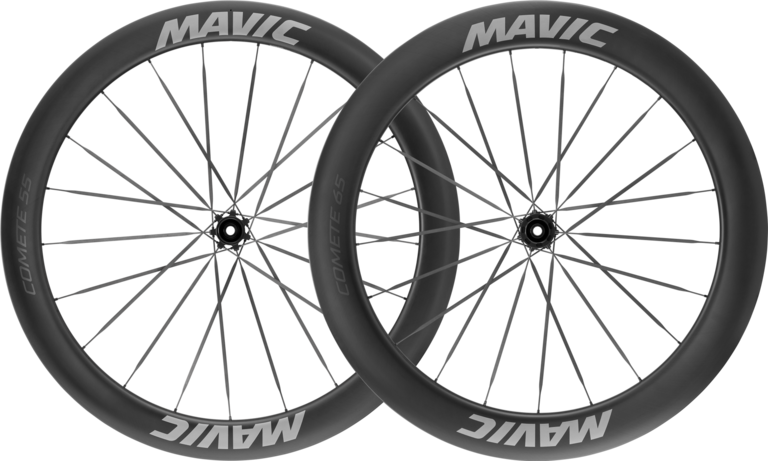
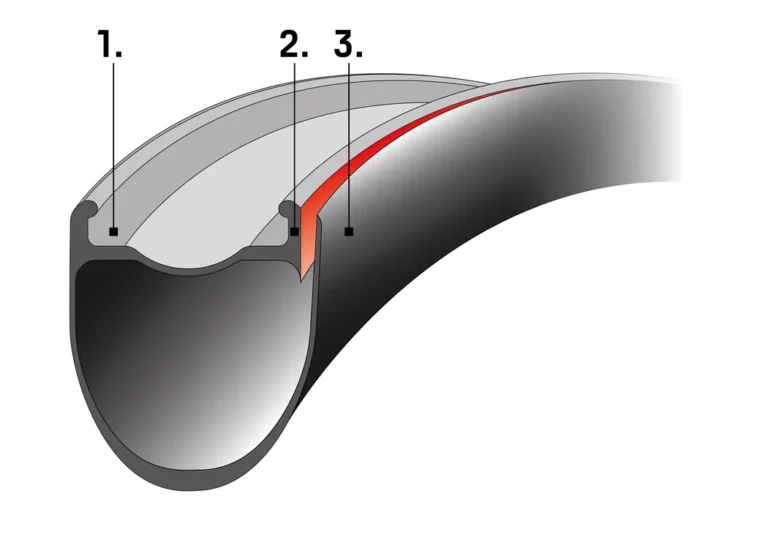
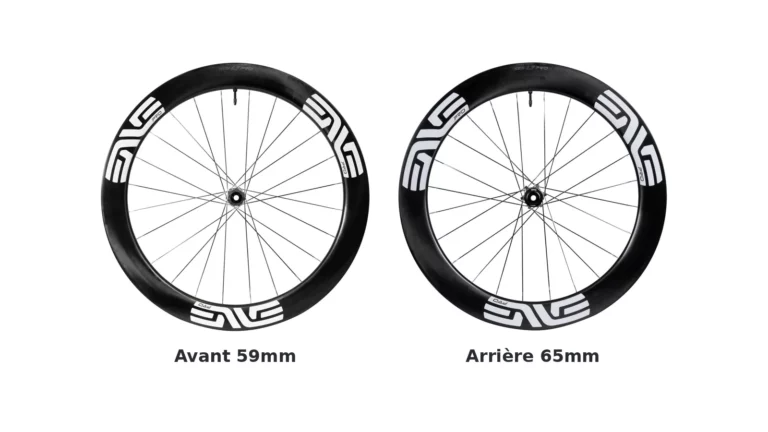
The rim moves to 25mm internal width (24.8mm on the detailed spec sheet, ETRTO 622x25TC) for 34mm external width. It remains hooked, UST Tubeless Ready, with Adaptive Layup (T700, T1000 and 3K fibres). The actual rim depths measure 45.2mm front and 55.2mm rear on the 45/55, 55.2mm and 64.6mm on the 55/65. The front wheel is always 10mm shallower than the rear: handling precision at the front, aero at the rear.
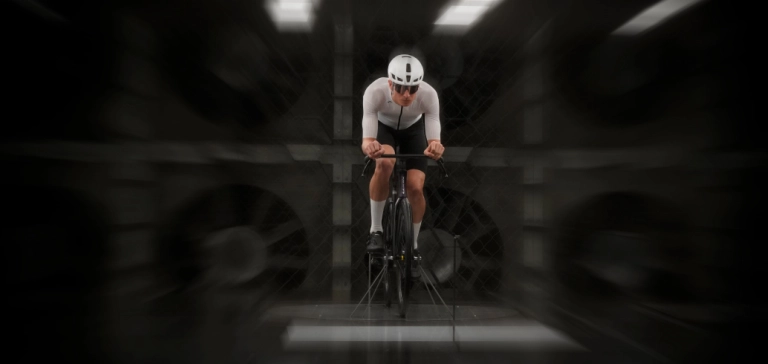
Mavic claims that a 25mm rim / 30mm tyre pairing is 11% more efficient in rolling resistance than a 23/28 pairing. Credible, but this gain owes at least as much to the switch to a 30mm tyre as to the rim itself. Two limits on the Mavic spec sheet: 29mm minimum tyre width and 5 bar (73 psi) maximum pressure. In terms of use, the brand steers the Mavic Comète 45/55 towards routes with real climbs, and the Comète 55/65 towards fast events with under 1500m of elevation gain.
Carbon spokes, ID360 hub and ceramic bearings on the new Comète
Each wheel gets 21 straight-pull carbon spokes in a 14/7 pattern: 14 two-cross on the disc side at the front and the cassette side at the rear, 7 radial on the opposite side, with locked heads to stabilise tension. The hub uses the 40-tooth Instant Drive 360 system (9° engagement), with aluminium body and axle and Mavic Ceramic bearings. Shimano HG-R 11/12-speed or SRAM XDR 12/13-speed freehub body, Campagnolo N3W kit as an option, 12×100 and 12×142 thru-axles, Centerlock disc brakes. Each wheel is assembled by hand in the Mavic lab in Chavanod, and the Mavic Comète are eligible for Mavic’s lifetime warranty.
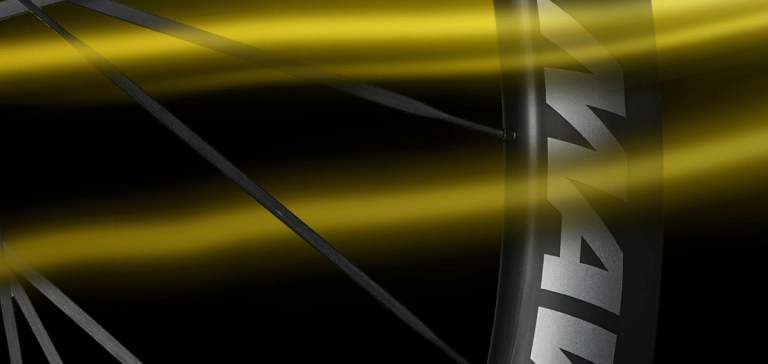
The Mavic Comète’s aero gains: watts against anonymous rivals
Mavic claims that the Aero Wide rim saves 5 to 10W in real-world wind (10 to 20° yaw), and that its 55mm wheel gains 1.6W in combined resistance (aero and rolling) against its “direct competitor”, and up to 9.1W against the rest of the panel. The classic problem: no competitor is named and the full protocol is not public. And 1.6W is a gap that your choice of tyre or pressure can wipe out. These figures remain in-house data, to be confirmed by independent tests. To measure what a few watts really count for on a route, our wheel comparison tool puts the promises into perspective.
Comète 85/85 and 85/Disc: the time trial and triathlon versions
The Mavic Comète 85 follow a different logic: 23mm internal and 31mm external rim width, with a 28mm reference tyre. The 85/85 weigh 1750g for €2499. The 85/Disc pair the 85mm front wheel with a disc rear wheel, for 1785g, i.e. €1149 for the front and €2599 for the rear. For the front wheel, Mavic claims 65.15W at 50km/h against 67.10W for a competitor, again anonymous, i.e. 1.95W better and 5.7W for the pair.
My verdict
The Mavic Comète 45/55 and 55/65 are the wheels the brand should have released from the start. In-house 25mm rim, rim depths differentiated by terrain, carbon spokes, ceramic bearings, freehub bodies compatible with all three standards, hand assembly in Haute-Savoie and a lifetime warranty: the spec sheet is complete and, above all, it finally reflects Mavic’s own choices rather than a response to the competition’s catalogue.
What raises an eyebrow: 1350g for €2499 is decent, not a benchmark, and the Comète 50 is lighter for the same price. The aero gains still rest on anonymous comparisons. The Mavic Comète 45/55 and 55/65 are the first real Comète of this new generation, more accomplished than the Comète 50, but at €2499 they will have to prove on the road that their 25mm rim is worth the gap with a competition that has often dragged the market downwards. Torn between the Comète 50 and the Comète 45/55? Tell us in the comments.
Mavic Comète 2026 technical specifications
| Comète 45/55 | Comète 55/65 | Comète 85/85 | Comète 85/Disc | |
|---|---|---|---|---|
| Rim depth (F / R) | 45,2 / 55,2mm | 55,2 / 64,6mm | 85 / 85mm | 85mm / disc wheel |
| Pair weight | 1350g | 1390g | 1750g | 1785g |
| Weight F / R | 600 / 750g | 620 / 770g | 820 / 930g | 820 / 965g |
| Internal width | 25mm | 25mm | 23mm | 23mm |
| External width | 34mm | 34mm | 31mm | 31mm |
| Reference tyre | 30mm (29mm min) | 30mm (29mm min) | 28mm | 28mm |
| Max pressure | 5 bar (73 psi) | 5 bar (73 psi) | N/A | N/A |
| Spokes | 21 / 21 carbon (14/7) | 21 / 21 carbon (14/7) | 21 / 21 carbon (14/7) | 21 carbon (14/7) at the front |
| Hubs | Mavic ID360, 40 teeth | Mavic ID360, 40 teeth | Mavic ID360, 40 teeth | Mavic ID360, 40 teeth |
| Bearings | Mavic Ceramic | Mavic Ceramic | Mavic Ceramic | Mavic Ceramic |
| Freehub body | Shimano HG-R, SRAM XDR, Campagnolo N3W (kit) | Shimano HG-R, SRAM XDR, Campagnolo N3W (kit) | Shimano HG-R, SRAM XDR, Campagnolo N3W | Shimano HG-R, SRAM XDR, Campagnolo N3W |
| Brakes | Centerlock disc | Centerlock disc | Centerlock disc | Centerlock disc |
| Axles | 12×100 / 12×142 | 12×100 / 12×142 | 12×100 / 12×142 | 12×100 / 12×142 |
| Tyre compatibility | UST Tubeless Ready, hooked | UST Tubeless Ready, hooked | Tubeless, hooked | Tubeless, hooked |
| Price | 2499€ | 2499€ | 2499€ | 3748€ |
Leave a Reply