
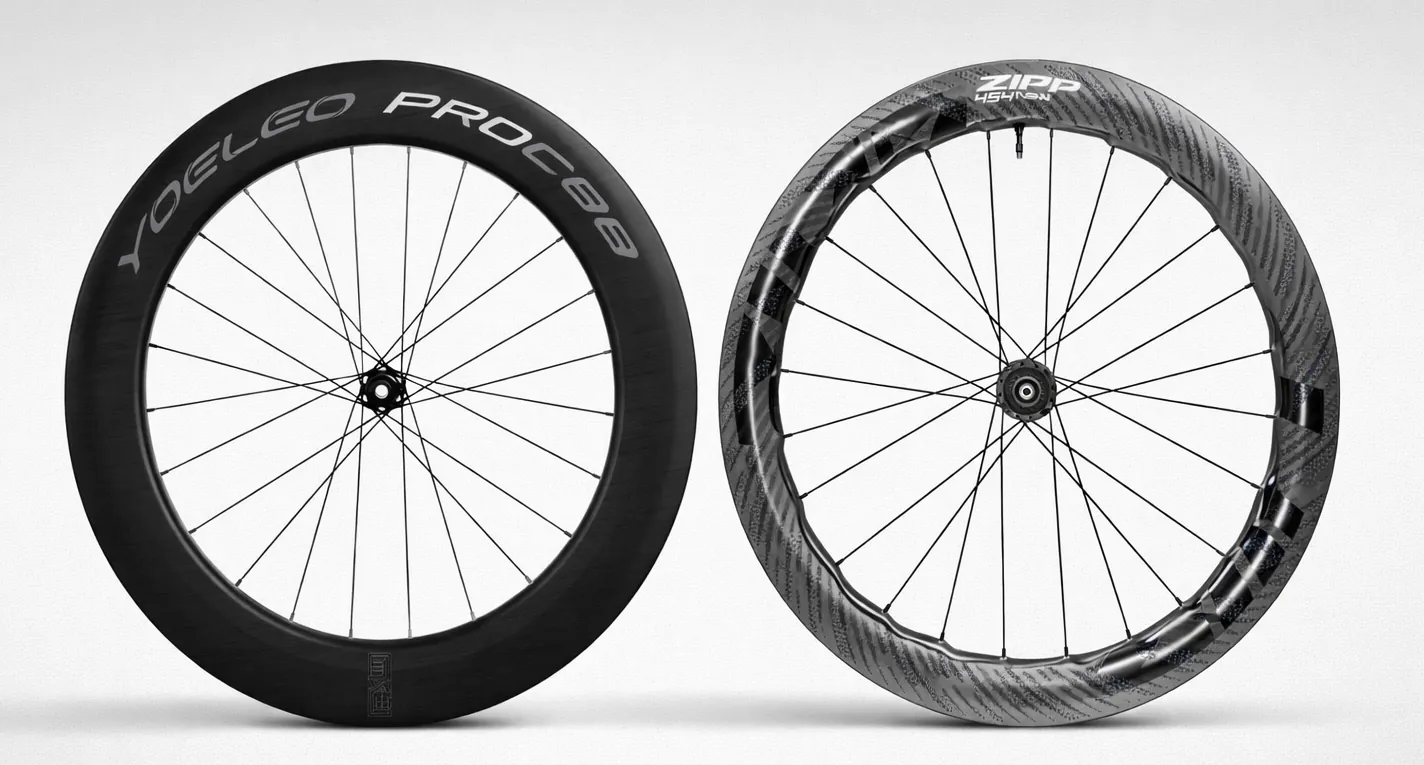
Chinese carbon wheels: a threat to the brands or a revolution for cyclists?
The market for high-end road bike wheels is going through an unprecedented transformation. For decades, a handful of Western brands dominated the premium carbon segment, with prices that could exceed €3,000 for a pair of wheels. This situation was accepted as the norm: innovation, quality and performance came at a price.
Today, that equation is being upended by the mass arrival of Chinese carbon wheels at unbeatable prices, often three to four times cheaper than their Western equivalents. These carbon bike wheels made in China raise a fundamental question: are we witnessing a welcome democratisation of carbon technology or an existential threat to the brands that built this market?
A scenario already seen in mobile phones
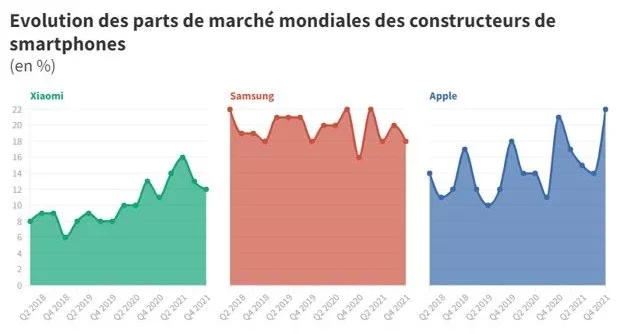
This phenomenon is not new. It recalls the disruption of the mobile phone industry by Xiaomi and Huawei around ten years ago. These Chinese brands offered smartphones with technical specifications comparable to the iPhone and Samsung, at half or a third of the price. Today, Xiaomi is the world’s third-largest smartphone manufacturer, and Huawei dominated the market before the American sanctions.
In all these cases, the pattern is identical: industrial expertise + direct sales or reduced margins + real innovation = price disruption without major compromise on quality. The road carbon wheel market is following exactly the same trajectory.
Why Chinese carbon wheels are changing the game
Mastery of industrial carbon production
China has become the world capital for manufacturing carbon frames and components for road bikes. What began as subcontracting for the big Western brands has turned into independent expertise. Chinese factories now make road carbon wheels for many premium brands that simply add their logo.
This industrial expertise is accompanied by massive investment in R&D. Chinese carbon wheel manufacturers no longer just copy: they innovate with aerodynamic profiles optimised in the wind tunnel, sophisticated carbon lay-ups and cutting-edge manufacturing processes comparable to European standards.
The direct-to-consumer sales model
The traditional business model of bike wheel brands involved multiple intermediaries: importer, distributor, retailer. Each link added its margin. Chinese carbon wheel manufacturers have bypassed this chain by selling directly via platforms such as AliExpress, their own websites, or specialist resellers with reduced margins.
This removal of intermediaries largely explains the price gap in carbon bike wheels, far more than the intrinsic quality of the product. A pair of 50mm carbon wheels can thus cost €600 instead of €2,500 for similar technical performance.
The democratisation of technical know-how
Manufacturing road carbon wheels is no longer a mysterious science reserved for a few historic brands. The processes are documented, composite materials are accessible, and quality standards are known. What was once an exclusive competitive advantage has become widely shared industrial know-how, allowing Chinese carbon wheels to reach high levels of quality.
Impact on established wheel brands
Short term: price disruption and strategic repositioning
Established bike wheel brands face an unprecedented strategic dilemma. Some choose to maintain their premium positioning by emphasising after-sales service, lifetime warranty and brand heritage. Others launch more affordable sub-brands or adjust their pricing in the face of competition from Chinese carbon wheels.
The immediate risk is margin compression. When a consumer can get a pair of 50mm road carbon wheels for €600 instead of €2,500, justifying that price difference becomes a perilous exercise for traditional brands.
We are already seeing major adjustments: price cuts from some historic players, more and more promotions, and above all increased communication on differentiating factors such as after-sales service, crash replacement warranties or certified production traceability.
Medium term: accelerated market segmentation
The carbon bike wheel market is now structured into three distinct segments, creating new opportunities for cyclists:
The premium segment (>€3,000) will remain for cyclists seeking absolute excellence, ready to pay for the last percentage of aerodynamic performance, exemplary after-sales service and the social recognition of a prestigious brand. The historic brands will keep their legitimacy there against Chinese carbon wheels.
A mid-range segment (around €1,500) is emerging with Western brands offering better value for money, sometimes sourcing from Asia themselves but keeping strict quality control and solid customer service. These road carbon wheels offer an interesting compromise.
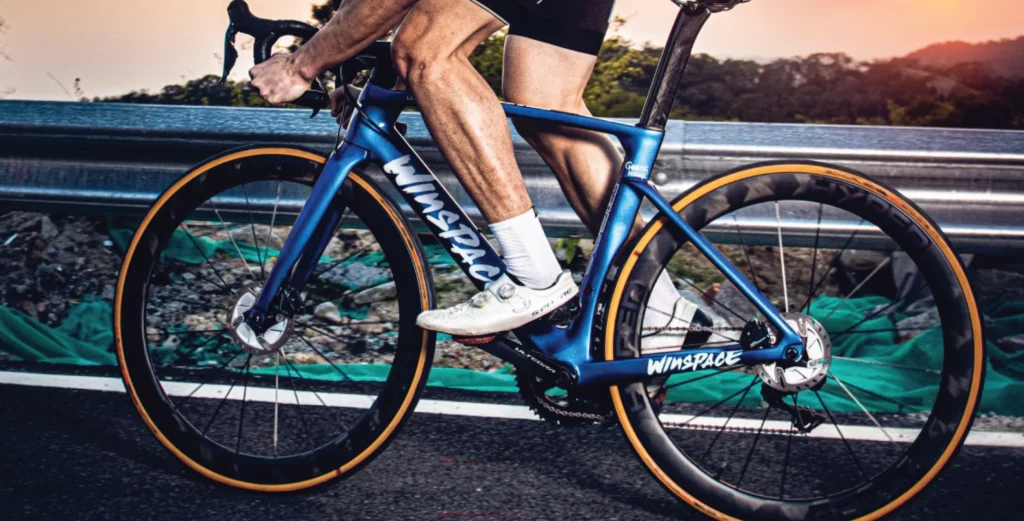
The affordable segment (<€1,000) is growing fast with Chinese carbon wheels sold direct, attracting rational cyclists willing to take a measured risk on after-sales service to access carbon technology at a lower price. Brands such as Yoeleo, Winspace, Elitewheels, ICAN or Lightcarbon offer high-performance wheels at €500-900 a pair, with serious technical specifications, ISO certifications and a track record of thousands of kilometres ridden by satisfied users documented on cycling forums.
Long term: standardisation and consolidation of the sector
As the quality of Chinese carbon wheels continues to improve and their reliability is established over thousands of kilometres, we could see a standardisation of the market similar to what happened in consumer electronics.
The bike wheel brands that survive will be those able to demonstrate tangible added value: genuine technological innovation, optimised system integration, an exceptional customer experience, or a lifestyle brand positioning that goes beyond the simple technical performance of road carbon wheels.
Lessons from the phone disruption: Xiaomi
The Xiaomi precedent: from copying to innovation
In 2011, Xiaomi launched its first smartphone at $300 with specifications comparable to the iPhone 4S sold at $650. Western analysts predicted mediocre quality and a short lifespan. Thirteen years later, Xiaomi is the world’s third-largest manufacturer, present in 100 countries, with real innovations (120W fast charging, 200MP cameras, folding screens).
The parallel with Chinese carbon wheels is striking:
- Phase 1 (2011-2014): Xiaomi copies designs and undercuts prices, amid general scepticism
- Phase 2 (2015-2018): Improved quality, R&D investment, gradual recognition
- Phase 3 (2019-today): Its own innovation, a premium image, head-on competition with Apple
Chinese wheel brands such as Winspace or Yoeleo are today between phases 2 and 3: established quality, growing investment in wind tunnel testing and R&D, and the beginnings of recognition in the international amateur peloton.
Key lesson for cycling: Apple survived by innovating continuously (iPhone, services, ecosystem). Nokia and BlackBerry, which stood still and relied on their reputation, disappeared. Premium wheel brands must choose their camp.
Concrete opportunities for cyclists
Democratised access to carbon technology
For the first time, high-performance road carbon wheels are within reach of modest budgets thanks to Chinese carbon wheels. An amateur cyclist can now buy 50mm carbon wheels for the price of a pair of high-end aluminium wheels ten years ago.
This democratisation allows more cyclists to benefit from the real advantages of carbon: optimised weight, lateral stiffness, effective aerodynamics. The performance gain from carbon bike wheels is no longer reserved for a wealthy elite or professional riders.
More choice and customisation
The range of Chinese carbon wheels has diversified considerably. Cyclists can now choose from dozens of different profiles, varied rim depths (from 25mm to 85mm), and configurations specific to their discipline: road, gravel, triathlon, time trial.
This variety encourages experimentation. Some cyclists no longer hesitate to own several pairs of road carbon wheels suited to different weather conditions or routes, where the prohibitive cost of traditional brands previously limited them to a single all-round set.
A revolutionary performance-to-price ratio
Independent wind tunnel tests show that many Chinese carbon wheels offer aerodynamic performance, lateral stiffness and reliability comparable to premium models at three or four times their price. For the pragmatic cyclist analysing the objective data, this finding about carbon bike wheels is hard to dispute.
This measurable reality is forcing the industry to question itself and pushing established bike wheel brands to justify their prices with concrete elements rather than the prestige of their name or their marketing heritage alone.
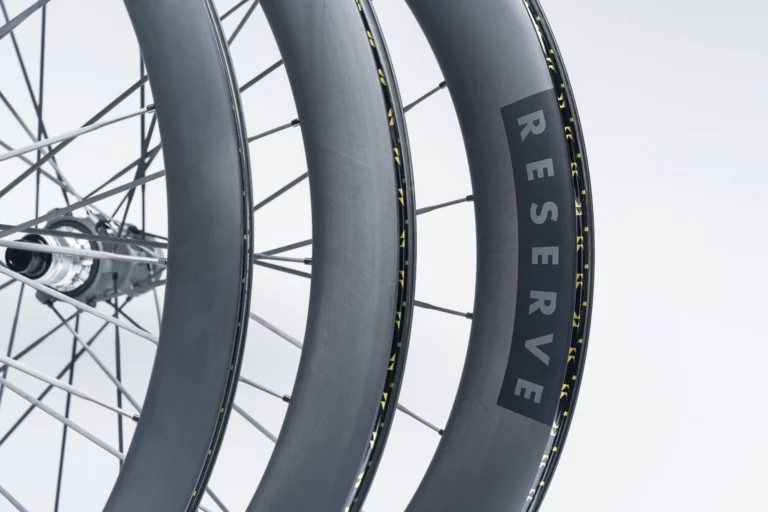
The excellent Nero Cycling carried out wind tunnel tests on the Chinese Caden wheels. The result: they are on the same level as, and sometimes better than, their competitors in the exercise (Roval, Reserve and Scope).
Buying guide: how to choose your carbon wheels
Selection criteria for Chinese carbon wheels
The first reflex should be to check the manufacturer’s reputation. Not all brands are equal, and a verifiable track record remains the best indicator of seriousness. Brands such as Yoeleo (founded in 2008, more than 50,000 pairs sold), Winspace (sponsor of continental teams) or Elitewheels (a specialist in optimised aerodynamic profiles) have accumulated enough positive feedback on specialist forums to be considered safe bets. Conversely, a brand with no documented presence on social media or Reddit r/cycling deserves the greatest caution.
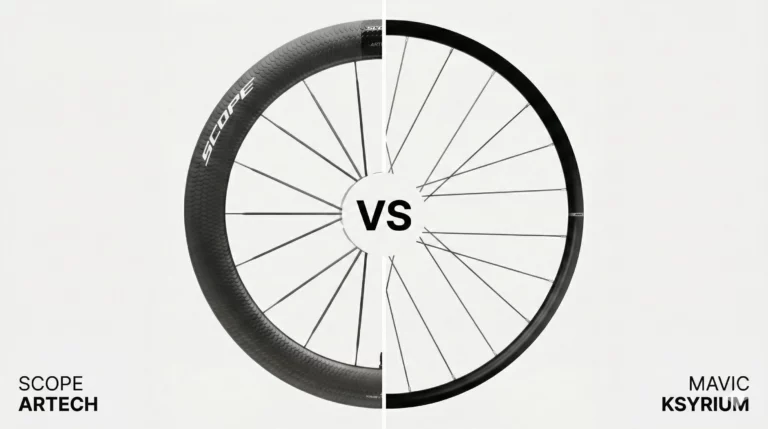
⚔️ Carbon wheel duel
Chinese vs Premium — Compare specs and prices in one click
On the technical side, you should check the actual specifications rather than the catalogue ones: weight measured on a scale, effective internal width (19mm minimum for modern 25-28mm tyres), brake compatibility (rim or disc) and axle standards (QR, 12mm, 15mm). Also check that there is a reachable after-sales service, with the option of ordering spare parts — spokes, bearings, freehub body — because that is often where the problem lies. A minimum two-year warranty against manufacturing defects is a non-negotiable sign of confidence.
When to favour established brands
It would be dishonest to claim that Chinese brands suit every profile. For a cyclist riding more than 10,000 km a year, taking part in races, or weighing more than 85 kg, the proven reliability and responsive after-sales service of brands such as Zipp, DT Swiss, Mavic or Campagnolo justify the price gap. The question of rim braking is particularly sensitive: on repeated descents of Alpine passes, the heat management of Chinese rims remains inferior to that of the premium benchmarks, with a real safety risk. Finally, the big brands have a network of partner workshops, crash replacement programmes and guaranteed parts availability over several years. A comfort that Chinese manufacturers, even the most serious ones, cannot yet offer on the same scale.
Strategic recommendations
For established bike wheel brands
The survival of the historic brands will not come through cosmetic marketing. Small incremental changes will no longer be enough to justify a 300% gap against Chinese competitors that publish comparable wind tunnel results. What is needed is breakthrough innovation: system integration technologies, profiles developed in partnership with WorldTour teams, and compatibility designed for Shimano Di2 or SRAM AXS electronic drivetrains.
In this context, after-sales service becomes a differentiator as important as pure performance. Crash replacement programmes at preferential rates, responsive 48-hour after-sales service, partner workshops able to step in quickly, spare parts guaranteed for ten years: that is what brands such as DT Swiss, Enve or Campagnolo can offer and what Chinese manufacturers, even the best organised, still struggle to match on a global scale. Transparency is also playing a growing role: publishing wind tunnel data, tracing the origin of carbon fibres, certifying ISO 9001 production processes. These steps, still rare in the industry, are becoming selling points in their own right against competitors whose origins are sometimes unclear.
For carbon wheel buyers
Before buying, research is essential. Not all Chinese wheels are equal, and the real risks (delamination, failure under load, hub failure) do exist on products from brands with no track record. Spending a few hours on Weight Weenies, specialist French-language forums or Facebook groups of experienced cyclists is the best possible investment before spending €700.
You also need to be honest in assessing your real needs. An occasional cyclist covering 3,000 km a year on rolling terrain does not need €3,000 wheels to enjoy their rides. On the other hand, a regular racer or a heavier rider, above 90 kg, has good reasons to turn to an established brand, if only for peace of mind and reliable after-sales service. Thinking about the cost over five years rather than the purchase price alone often changes the equation: a pair of Chinese wheels with no real warranty can end up costing more than a pair of Mavic or DT Swiss wheels with a lifetime warranty. Finally, for those still hesitating, the most cautious strategy remains simple: start with Chinese wheels from an established brand for training, and keep your premium wheels for races and important rides. The best way to form an opinion is still to try it for yourself.
The future of the carbon bike wheel market
Emerging trends
The first likely movement is a consolidation of the market. The dozens of current Chinese brands will not all survive: players with no track record, no after-sales service and no certification will gradually disappear in favour of a few well-established names. We can already see it in the strategic decisions of Winspace, which is investing in sponsoring UCI Continental teams and forging partnerships with European distributors, or of Yoeleo, which has opened warehouses in Germany and the United States to cut delivery times and improve its local after-sales service. This move towards professionalisation looks exactly like what Xiaomi went through between 2014 and 2018.
In parallel, the cycling industry is converging on common standards — 21mm internal width, widespread tubeless ready, universal axle compatibility — which mechanically reduce the competitive advantage of proprietary solutions. When a Yoeleo and a Zipp accept the same tyres, the same valves and the same cassettes, the battlefield inevitably shifts to price, service and brand image.
The Chinese move upmarket is perhaps the most significant trend to watch. ICAN sponsors professional Ironman triathletes, Lightcarbon equips influencers, and Elitewheels is developing ultra-light models at €1,200-1,500 with specifications once reserved for the Western premium segment: 25mm internal width, DT Swiss hubs, lifetime warranty. These brands are no longer trying to be cheap, they are trying to be better. Finally, some Western brands are themselves learning the lessons of this reality by creating discreet partnerships with quality Chinese factories, combining Asian manufacturing expertise with their own quality control, design and distribution network.
Likely scenarios over 5 years
Three trajectories are conceivable, and none can be ruled out. In the scenario most favourable to established brands, consumers continue to value service, warranty and reputation enough to accept a price premium of around 50 to 100%, that is around €1,500-2,000 for a premium pair against €800-1,000 for a Chinese pair with equivalent performance. Brands such as Zipp, Enve or Campagnolo keep their legitimacy in the high-end segment while the Chinese brands dominate the middle of the market.
In a more disruptive scenario, the quality of Chinese wheels improves to the point where only a minority of professional cyclists or die-hard enthusiasts still justify buying premium. The industry would then be forced into a major restructuring, comparable to what the photography industry went through with the rise of smartphones. Widespread price cuts from Western brands would become inevitable, leading to consolidations and perhaps disappearances.
The most likely scenario, however, remains that of a stable balance between well-defined segments, each type of wheel finding its audience according to clearly differentiated priorities: price for some, absolute performance measured in the wind tunnel for others, service and peace of mind for others still, and brand image for those who see their wheels as a badge of belonging as much as a piece of technical equipment. This three-tier segmented market is precisely the one produced by the Xiaomi disruption in mobile phones — and it has proved viable for all parties.
Towards a new market balance
The emergence of Chinese carbon wheels is neither a catastrophe nor a miracle. It is a natural evolution of a market reaching technical maturity, where production is being rationalised and technological barriers to entry are gradually falling.
Historic bike wheel brands will keep a legitimate place for consumers who value prestige, premium after-sales service or certified cutting-edge innovation. But they will have to earn that position through tangible proof of measurable superiority, not just through their history or their marketing.
Chinese carbon wheel manufacturers will continue to gain market share by constantly improving their quality, reliability and credibility with cyclists. The most visionary among them will invest heavily in international customer service and in building lasting brands rather than competing on low prices alone.
Buyers of carbon bike wheels are the big winners of this market transformation. They benefit from significantly lower prices, a much wider and more diverse range, and a cycling industry forced to innovate for real and to question itself. What remains is to navigate intelligently through this new complexity, where price is no longer an automatically reliable indicator of quality or performance.
FAQ: frequently asked questions about Chinese carbon wheels
Where can you buy Chinese carbon wheels safely?
There are three channels, with different levels of risk and price. The safest is the brand’s official website (yoeleo.com, winspace.cc, ican-cycling.com, elitewheels.cc): you buy direct, with no intermediary, with the full manufacturer’s warranty. The downside is the delivery time from China (10-20 days) and the customs duties to plan for.
Second option: the official storefronts on AliExpress. The main brands — Elitewheels, SuperTeam and CSC — have verified shops on the platform, recognisable by their “Official Store” badge. The advantage is AliExpress buyer protection in the event of a dispute, regular promotions (11/11, summer sales), and sometimes shipping from warehouses in Spain or Poland, which avoids customs duties. This is the channel I recommend for a first purchase, as it offers the best balance of safety and price.
To be avoided in all cases: nameless sellers on AliExpress offering “Zipp style” or “Enve style” wheels at knock-down prices, and batches with no certifications shown.
Are Chinese carbon wheels as reliable as Western brands?
Reliability depends entirely on the brand chosen. Established manufacturers such as Yoeleo, Winspace, ICAN, Elitewheels and Lightcarbon have proved themselves over thousands of kilometres ridden by satisfied users. These brands use the same carbon fibres (often Toray T700 or T800) and manufacturing processes similar to those of premium brands.
The key is to favour brands with:
- A track record of several years (5+ years)
- ISO 9001 certifications and EN standards
- Positive feedback on cycling forums (Weight Weenies, Reddit r/cycling)
- An existing after-sales service with spare parts available
Avoid unknown brands sold only on AliExpress with no verifiable track record.
What is the real difference between an €850 Yoeleo and a €2,500 Zipp 404?
In terms of pure performance (aerodynamics, stiffness, weight), independent wind tunnel tests show minimal differences, often of the order of 1-2 watts at 40 km/h.
The real differences lie elsewhere:
- After-sales service: Zipp offers crash replacement (replacement at a reduced price in the event of breakage) and a worldwide dealer network. Yoeleo has an after-sales service, but a less developed one.
- Warranty: Zipp often offers a lifetime warranty against manufacturing defects. Yoeleo generally offers 2-3 years.
- Parts availability: Zipp guarantees the availability of spare parts for 7+ years. For Yoeleo, this is less certain in the long term.
- Brand prestige: Zipp is visible in the WorldTour, Yoeleo in amateur pelotons.
For an amateur cyclist riding 5,000 km a year, the performance difference probably does not justify the €1,650 gap. For a demanding racer or a heavy rider (>90kg), premium after-sales service may be worth the investment.
Can I use Chinese wheels in competition?
Yes, absolutely. Chinese carbon wheels from established brands comply with UCI (Union Cycliste Internationale) standards and are legal in amateur and even professional competition (although rare in the WorldTour for sponsorship reasons).
Recommendations by level:
- Local/regional races: Yoeleo, Winspace and ICAN are perfectly suitable
- National championships: Favour high-end models (Winspace Hyper, Elitewheels Drive) or premium brands for maximum reliability
- International competitions: If you are aiming for the podium, the responsive after-sales service and guaranteed availability of replacement wheels from premium brands (Zipp, Enve, Campagnolo) justify the investment
Many Ironman triathletes now use ICAN or Elitewheels wheels successfully.
What is the risk in the event of breakage or a technical problem?
This is the main drawback of Chinese carbon wheels. If there is a problem:
Chinese brand scenario:
- Contact by email (response time: generally 24-72 hours)
- Remote diagnosis via photos
- Replacement part or wheel sent from China (lead time: 2-4 weeks)
- Potential customs charges on return
- No courtesy wheel
Premium brand scenario (Zipp, Enve, DT Swiss, Mavic, Campagnolo):
- Contact with a local distributor or hotline (response: 24-48 hours)
- Network of approved partner workshops
- Courtesy wheel sometimes available
- Crash replacement programme (replacement at a reduced price, around 40-60% of the retail price)
- Spare parts guaranteed to be available
Risk mitigation strategy:
- Buy two pairs of Chinese wheels for the price of one premium pair
- Keep a spare pair of aluminium wheels
- Check that the seller has a warehouse in Europe (Yoeleo Germany, for example)
Do Chinese wheels last over time (3-5 years)?
Feedback over 3-5 years is starting to build up for the established brands:
Yoeleo (founded 2008): Many reports of wheels with 30,000-50,000 km and no major problem. A few cases of bearings needing replacement (normal) and broken spokes (the same for all brands).
Winspace (founded 2006): Solid reputation in the triathlon community. Reliable wheels over several seasons.
ICAN: Mostly positive feedback, a few spoke-related problems reported but handled by after-sales service.
Lightcarbon: Good long-term reputation, particularly for rim brake wheels.
Elitewheels: A more recent brand but very positive feedback on build quality.
Point to watch: Durability depends a great deal on use (rider weight, type of terrain, maintenance). A 95kg rider in the mountains will put far more stress on the wheels than a 65kg rider on flat terrain.
Which Chinese brands should you absolutely avoid?
Without naming specific names, avoid:
- Brands with no website of their own (present only on AliExpress)
- Prices that are too low (50mm carbon wheels at €300 = warning sign)
- Brands with no user feedback at all on cycling forums
- Sellers who refuse to give precise technical information (actual weight, exact internal width, origin of the hubs)
- Brands with no minimum warranty (2 years minimum)
Simple rule: If you cannot find at least 10 detailed reviews on Weight Weenies, Reddit r/cycling or French-language forums, move on.
Do I have to pay customs duties?
From China to the European Union:
- Value < €150: VAT only (20%)
- Value > €150: VAT (20%) + customs duties (4.7% for bikes/components) + carrier handling fees (€15-30)
Example for €800 wheels:
- Product price: €800
- VAT (20%): €160
- Duties (4.7%): €37.60
- Handling fees: ~€25
- Total: ~€1,022
Strategies to avoid/reduce them:
- Buy via a European distributor (Yoeleo Germany, some resellers)
- Check whether the price shown includes tax or is before tax and duties
- Group several purchases to optimise the fixed costs
Warning: Some sellers under-declare the value (illegal and risky – a fine if discovered by customs).
Can I set up my Chinese wheels tubeless easily?
Most modern Chinese carbon wheels are tubeless ready, but sealing quality varies:
Brands with a good tubeless reputation:
- Yoeleo: Tubeless rim tape fitted as standard, easy setup
- Winspace: Excellent sealing reported
- ICAN: Tubeless ready, sometimes needs extra tape
- Elitewheels: Good feedback on tubeless setup
Setup tips:
- Check that the rim tape is properly sealed (add tape if necessary)
- Use a compressor or high-pressure inflator for the initial setup
- Favour tyres known to fit well (Continental GP5000 TL, Schwalbe Pro One)
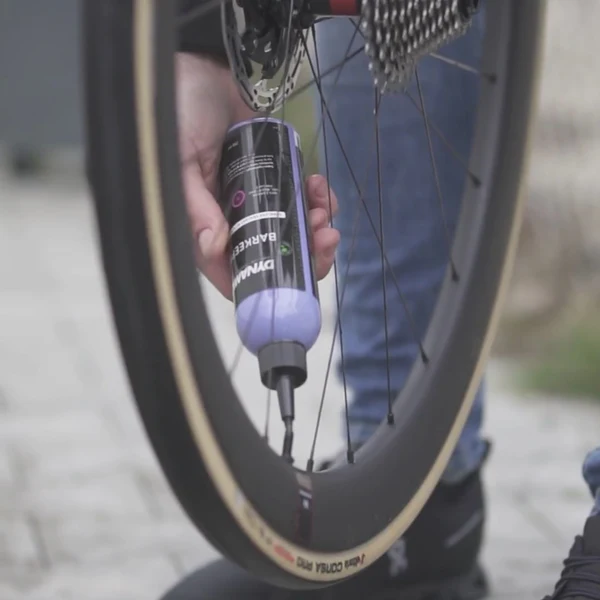
- Allow 50-100ml of sealant depending on tyre volume
Comparison with premium brands: Zipp, Enve and DT Swiss generally have rim beds optimised for tubeless with excellent sealing as standard. Less hassle during setup.
How can you spot a counterfeit premium wheel?
Some unscrupulous sellers sell Chinese wheels with fake Zipp, Enve or Campagnolo logos. This is illegal and not recommended (uncertain quality, no warranty).
Counterfeit warning signs:
- Price 70-80% lower than the official price (a Zipp 404 at €600 = counterfeit)
- Seller on AliExpress/DHGate offering “Zipp style” or “Enve style”
- No verifiable serial number
- Poor-quality logos (printing vs original decals)
- Declared weight different from the official specs
- Impossible to register the warranty on the brand’s official website
Legal and ethical solution: Buy genuine Chinese wheels (Yoeleo, Winspace, etc.) that stand by their identity. They offer excellent value for money without the legal and ethical risks of counterfeits.
Join the conversation
Does this transformation of the market by Chinese carbon wheels foreshadow the evolution of the whole high-end cycling sector? Will electronic groupsets, integrated frames and aerodynamic components go through the same price revolution?
How can historic bike wheel brands preserve their value in the long term in a world where manufacturing is globalised and technical information circulates instantly? Is the prestige of a century-old brand really worth €2,000 more for road carbon wheels that are technically equivalent in the wind tunnel?
Share your own experience: have you taken the plunge with Chinese carbon wheels, or are you staying loyal to the established brands? What really drives your choice: confidence in after-sales service, an affordable price, measured performance, brand image, or something else?
This article contains affiliate links. If you buy via these links, I receive a commission at no extra cost to you.
Leave a Reply