ETRTO: understanding bike tyre and rim sizes
In short
The ETRTO size of a tyre, for example 28-622, gives its nominal width (28 mm) followed by its inner diameter (622 mm). On a rim, 622x19TC gives the diameter (622 mm), the internal width (19 mm) and the profile (TC, hooked tubeless). Only the diameter in millimetres is reliable: inch and French markings are approximate. On a hookless (TSS) rim, ETRTO limits pressure to 5 bar on the road and sets a minimum tyre width according to the internal width. To check your combination: the rim and tyre compatibility calculator.
| Marking | What it means |
|---|---|
| 28-622 | Tyre: 28 mm nominal width, 622 mm inner diameter |
| 700x28C | The same tyre in French notation, approximate |
| 622x19TC | Rim: 622 mm diameter, 19 mm internal width, hooked tubeless |
| TSS | Hookless rim: 5 bar maximum on the road according to ETRTO |
28-622, 700x28C, 28×1.1: these three markings describe the same tyre. The first is the only one that leaves no room for doubt: it is the ETRTO size, adopted by the international standard ISO 5775. Understanding ETRTO means knowing how to read a tyre sidewall and a rim label, and avoiding compatibility mistakes, especially on hookless rims. Here is how to decode these figures, backed by manufacturer sources.
Contents
What is ETRTO?
ETRTO, short for European Tyre and Rim Technical Organisation, is the European body that sets and harmonises tyre and rim dimensions. For bicycles, its designation system was adopted by ISO in the standard ISO 5775, in two parts:
- ISO 5775-1 for tyres: designations and dimensions. The current version is the 7th edition, published in July 2023. It covers clincher, tubeless, tubeless ready and tube-type tyres, but not tubulars.
- ISO 5775-2 for rims, published in 2021: it defines the dimensions relevant to fitting and the designations of straight-side rims (SS, TSS), crotchet rims (C, TC) and hooked bead (HB) rims.
The point is simple: describe every tyre and every rim in millimetres measured at the same place, where the old inch and French designations overlapped.
Reading the ETRTO size of a tyre
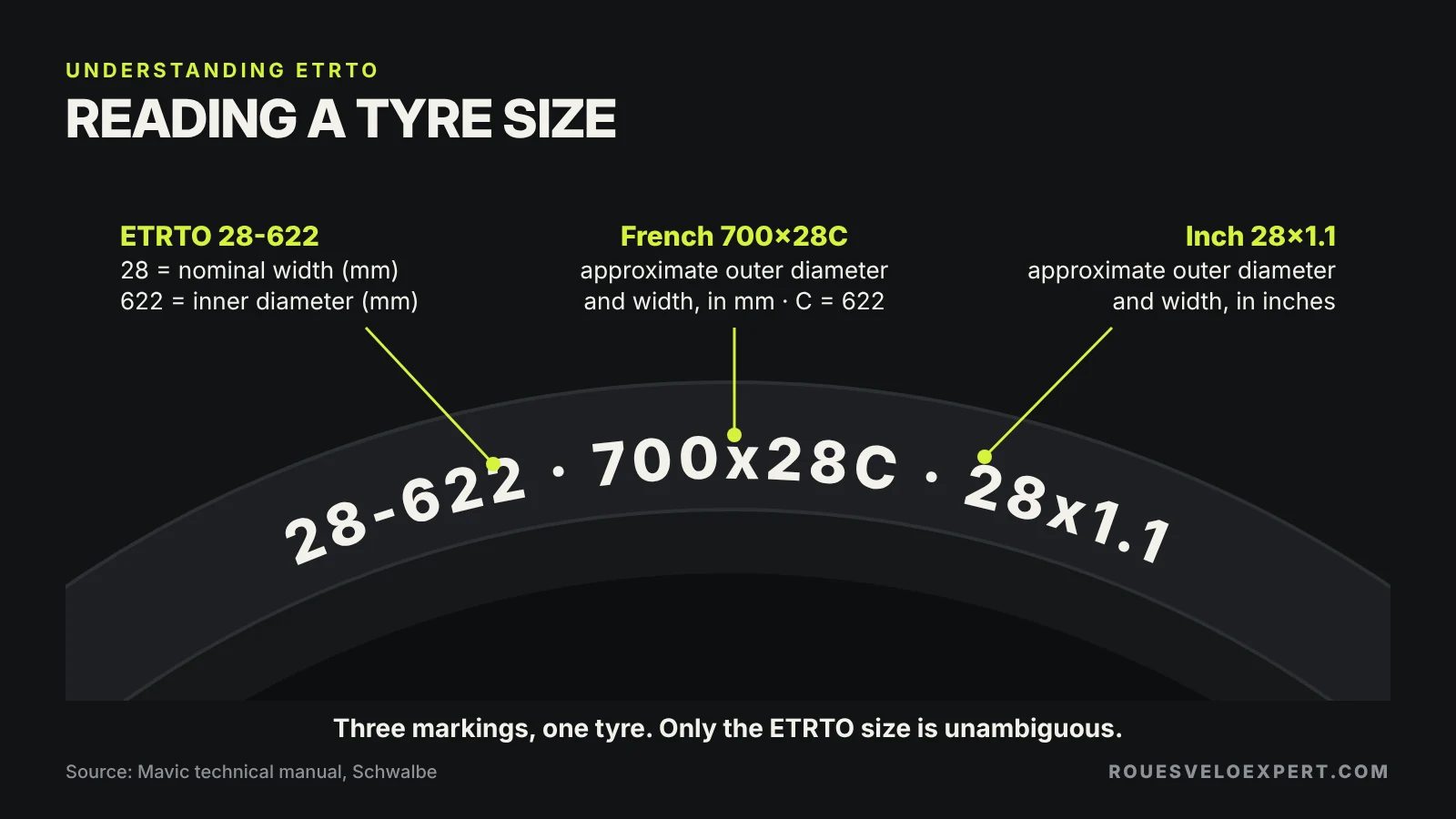
On the tyre sidewall, the ETRTO size takes the form of two numbers separated by a hyphen. Mavic uses the example of one tyre marked in three ways:
| Marking | Example | What it indicates |
|---|---|---|
| ETRTO | 28-622 | Width (28 mm) and inner diameter of the tyre (622 mm) |
| French | 700x28C | Approximate outer diameter and width, in mm |
| Inch | 28×1.1 | Approximate outer diameter and width, in inches |
In the French marking, the final letter refers to the inner diameter: according to Schwalbe, C stands for 622 mm. 650B corresponds to 584 mm, now sold as 27.5 inch.
Why inch sizes mislead
Schwalbe puts it bluntly: inch sizes lack precision. Several different diameters share the same name:
| ETRTO diameter | Common names |
|---|---|
| 622 mm | 700C, 28 inch in Europe, 29 inch for MTB |
| 584 mm | 650B, 27.5 inch |
| 559 mm | 26 inch MTB |
| 571 mm | 26 inch triathlon |
| 590 mm | 26 inch touring |
| 635 mm | 28 inch |
| 630 mm | 27 inch |
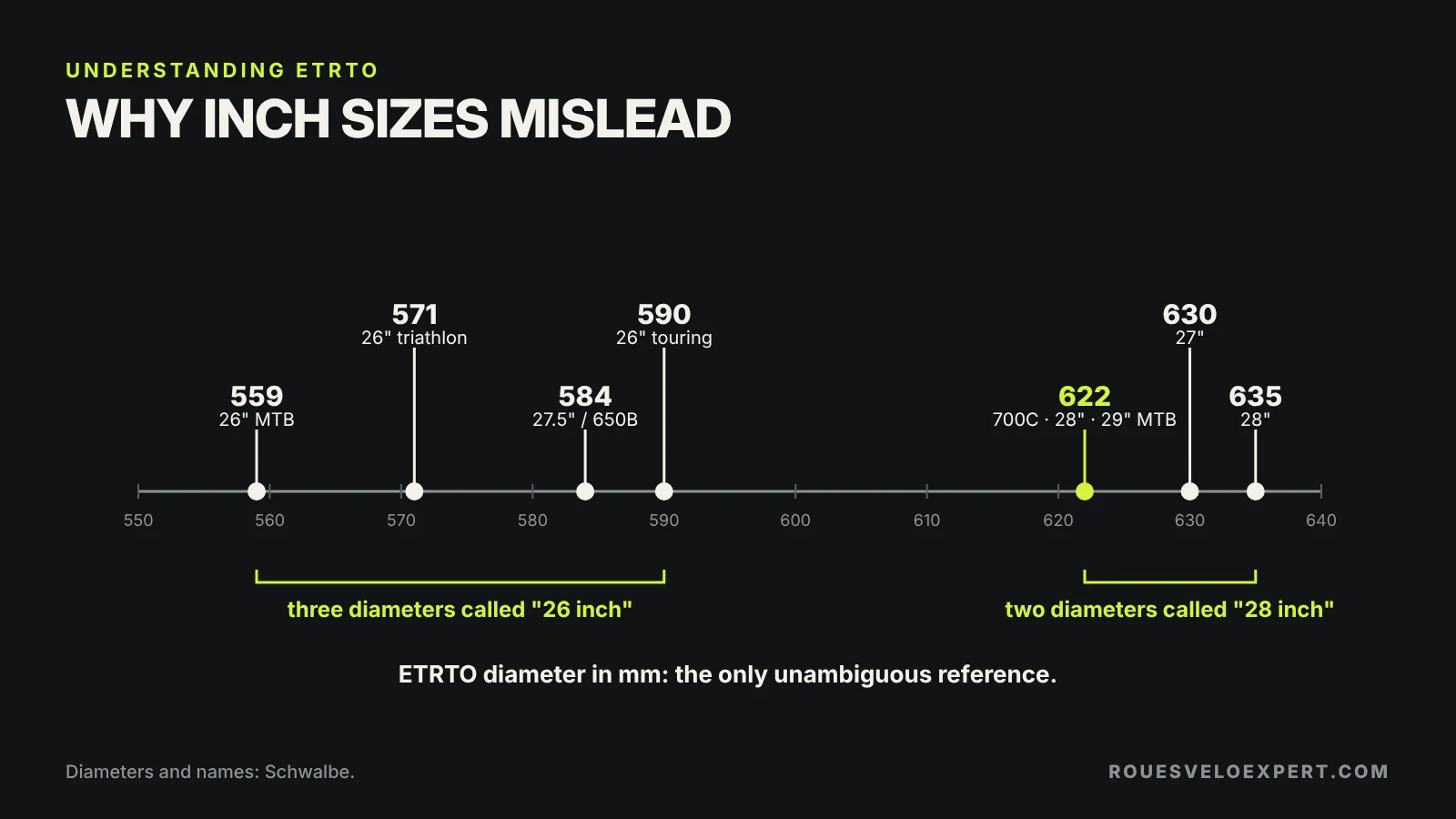
A “26 inch” can therefore mean three diameters that are incompatible with each other. Conversely, a 29 inch MTB tyre and a 700C road tyre share the same 622 mm diameter: only the width then decides compatibility. Another common trap: in “26 x 1.75”, the 1.75 is the tyre width in inches (about 44 mm), not a rim width. The ETRTO size moulded on the sidewall gives the exact value.
Reading the ETRTO size of a rim
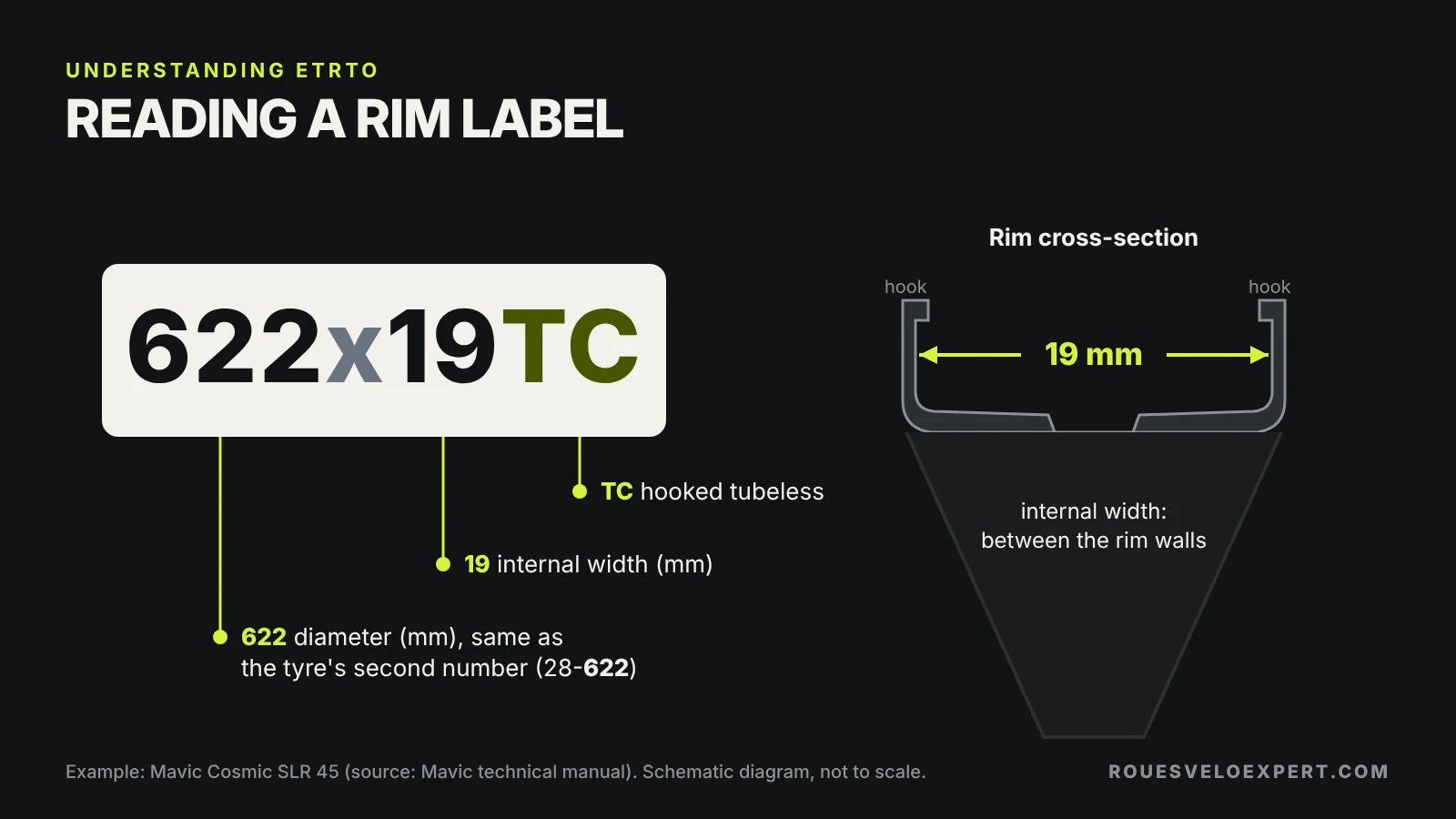
On a rim, the ETRTO designation usually appears on a label near the valve hole. Mavic gives the example of a Cosmic SLR 45 marked 622x19TC:
- 622: the diameter, which must match the inner diameter of the tyre;
- 19: the internal width, measured between the rim walls, in mm;
- TC: the profile type.
On our pages you will find, for example, the Mavic Comète 45/55, marked 622x25TC: 25 mm internal width, hooked.
C, TC, SS, TSS: the profile codes
| Code | Meaning | In practice |
|---|---|---|
| C | Crotchet (hooked) | Hooked rim, without tubeless specification |
| TC | Tubeless Crotchet | Hooked tubeless rim |
| SS | Straight Side | Straight walls, no hooks |
| TSS | Tubeless Straight Side | Tubeless rim without hooks, known as hookless |
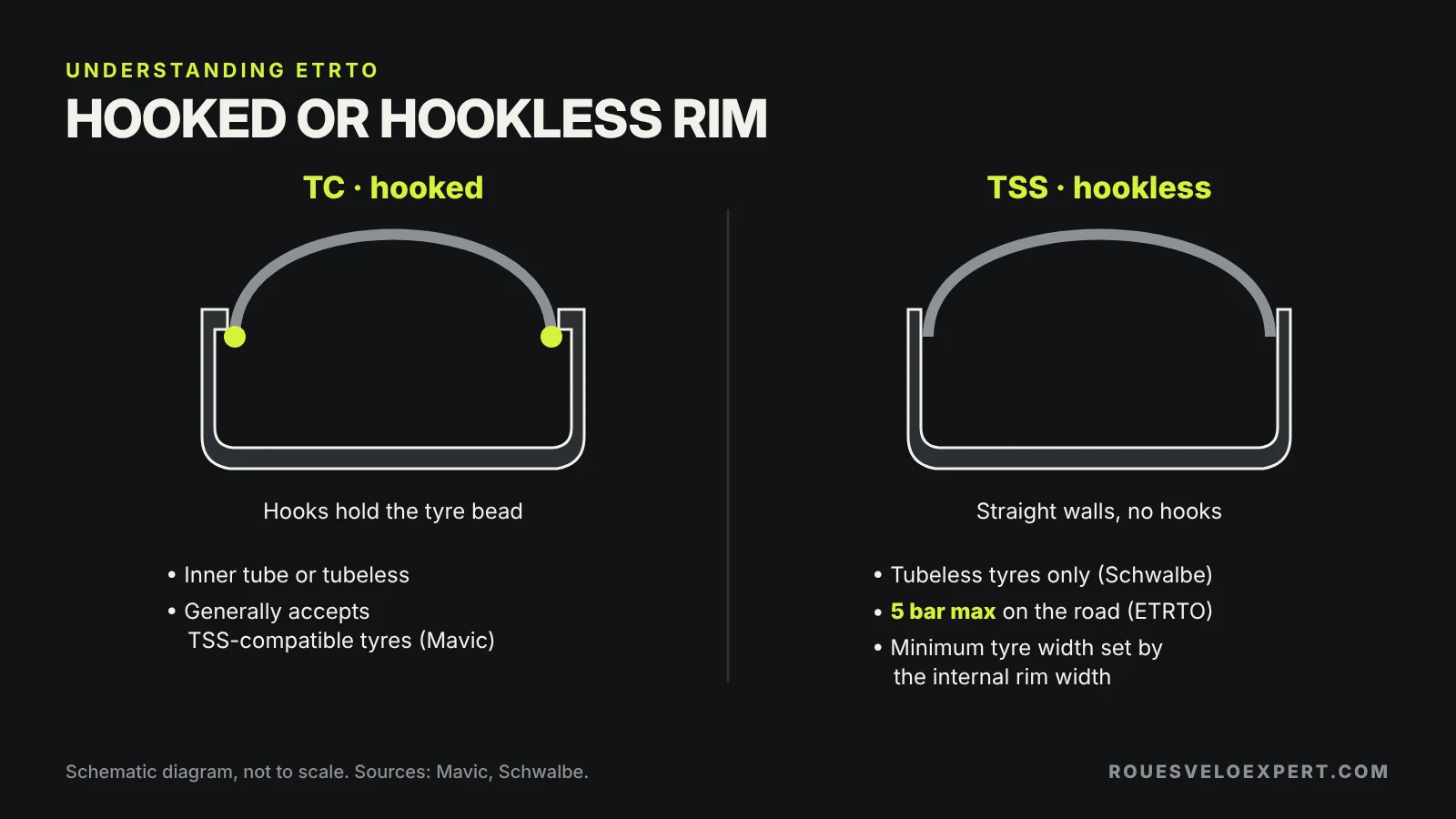
According to Mavic, a TSS-compatible tyre can generally be fitted to a TC rim, but not the other way round, and a TSS rim runs at lower pressures than a TC rim. Schwalbe specifies that a hookless rim must only take tubeless tyres (TLE or TLR in its range), whatever the use.
Why your tyre does not measure its stated width
The ETRTO width of a tyre is a nominal width, measured on a reference rim. Continental states that the internal width of its measuring rim is based on ETRTO recommendations, and that if your rim is wider or narrower, the actual tyre width changes. Schwalbe adds several nuances:
- manufacturers allow themselves a tolerance of plus or minus 3 mm, or less;
- a tyre is wider at maximum pressure than at low pressure;
- a new tyre keeps widening over time, by 1 to 2 mm;
- width is measured at the widest point.
The direct consequence: on a modern wide rim, check your frame clearance before fitting a tyre at its maximum width.
ETRTO and hookless rims: the rules to know
This is where the standard matters most. ETRTO rules for hookless rims cover rim dimensions, maximum pressure and minimum tyre width according to internal width.
1. A maximum pressure of 5 bar on the road
According to ETRTO, as Schwalbe points out, a hookless road bike rim is limited to 5 bar (72.5 psi). This limit applies even if the tyre sidewall shows a higher maximum pressure. If the rim states a lower limit, that is the one that counts. Continental also notes that pressure rises with heat, by about 0.17 bar for every 10 °C.
From the shop floor
One day, we delivered a bike to a customer fitted with Zipp 303 Firecrest wheels, which are hookless rims, with tyres set up tubeless. The customer saw fit to inflate them to 8 bar, well above the 5 bar limit. The inevitable happened: both tyres gave way, and the sealant ended up on just about every wall of his garage. On a hookless rim, maximum pressure is not a recommendation, it is a limit.
2. A minimum tyre width
The wider the rim, the wider the minimum permitted tyre. ENVE states, for example, that ETRTO and ISO recommend at least a 29 mm tyre on a hookless rim with a 25 mm internal width. Some wheel manufacturers nonetheless approve narrower tyres on their own rims, after their own testing: ENVE states that its own 27 mm tyre is approved on this type of rim. In that case, only the compatibility list published by your wheel manufacturer is authoritative.
3. Always go with the lowest value
Continental, Schwalbe and Mavic agree on the same rule: compare the limits given by the rim manufacturer and the tyre manufacturer, and go with the most restrictive. Continental gives the example of a 28-622 tyre limited by its manufacturer to a hookless rim of 23 mm internal width, while the rim manufacturer allows it up to 25 mm: 23 mm is the figure to follow.
Checking your combination in 4 steps
- Compare the diameters: the second number on the tyre (622) must be identical to the first number on the rim (622).
- Note the internal width and rim type: on the label (19TC, 25TSS…) or on the manufacturer’s spec sheet. Failing that, measure between the rim walls with a calliper.
- Check the width range: with the wheel manufacturer’s chart or our rim and tyre compatibility calculator.
- Cross-check the limits: maximum pressure and minimum width for the rim and the tyre, going with the lowest. The pressure calculator then helps you find the right riding pressure.
Conclusion: ETRTO, the only common language between tyre and rim
Inch and French markings stay on sidewalls out of habit, but only the ETRTO size describes a tyre and a rim precisely. For a road cyclist with inner tubes and hooked rims, remembering the diameter and internal width is enough in most cases. With hookless rims, the standard becomes a safety rule: maximum pressure, minimum width and the manufacturer’s compatibility list are not up for debate.
And you, have you ever had a nasty surprise with actual tyre width or compatibility when fitting a tyre? Tell us in the comments.
Frequently asked questions about ETRTO
What does ETRTO stand for?
ETRTO stands for European Tyre and Rim Technical Organisation. It is the European body that harmonises tyre and rim dimensions. For bicycles, its designation system is used by the international standard ISO 5775.
How do you read a tyre size such as 28-622?
The first number is the nominal tyre width in millimetres (28 mm), the second its inner diameter in millimetres (622 mm). A 28-622 corresponds to the French marking 700x28C.
Do a 700C tyre and a 29 inch MTB tyre have the same diameter?
Yes. Both have an ETRTO diameter of 622 mm. Compatibility then depends on the tyre width, the internal rim width and the frame clearance.
What do TC and TSS mean on a rim?
TC stands for Tubeless Crotchet: a hooked tubeless rim. TSS stands for Tubeless Straight Side: a tubeless rim without hooks, known as hookless. According to Mavic, a TSS-compatible tyre generally fits a TC rim, but not the other way round.
What is the maximum pressure on a hookless rim?
According to ETRTO, a hookless road bike rim is limited to 5 bar (72.5 psi), even if the tyre states more. If the rim or tyre manufacturer gives a lower limit, the lower one must be respected.
Sources
- ISO 5775-1:2023, bicycle tyres (ISO)
- ETRTO / ISO rim and tyre combinations (Mavic technical manual)
- Tyre size designations and road tubeless requirements (Schwalbe)
- Tyre width and rim width combinations (Schwalbe)
- Hookless or hooked rims (Continental)
- Hookless Rim Technology 101 (ENVE)
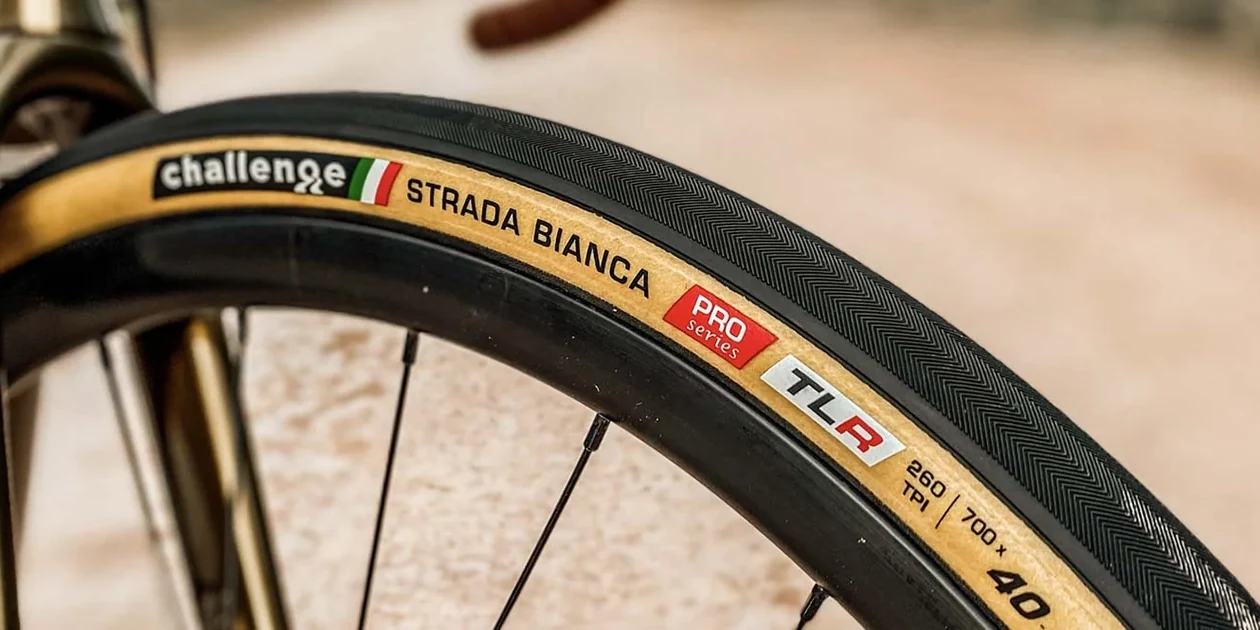
Featured photo: Challenge (Strada Bianca Pro TLR 700×40 tyre).