Princeton CarbonWorks: the story of the wavy wheels born from rowing
Princeton CarbonWorks is an American carbon wheel brand founded in May 2013 by former Princeton University rowers and based in Mystic, Connecticut. Its signature: a rim whose depth undulates in a sine wave, from 60 to 65 mm on the Wake 6560, to combine the efficiency of a deep wheel with the crosswind stability of a shallower one. These wheels carried Filippo Ganna to two time trial world titles and the Hour Record, and the brand stood up to SRAM in front of an American jury. Let’s dive into the story of Princeton CarbonWorks.
Princeton CarbonWorks at a glance
- Founded: May 2013, by Marty Crotty, Brad Werntz and Jack Leonard, joined by Harrison Macris, now CEO.
- Key technology: the variable-depth sinusoidal rim, with an undrilled rim bed.
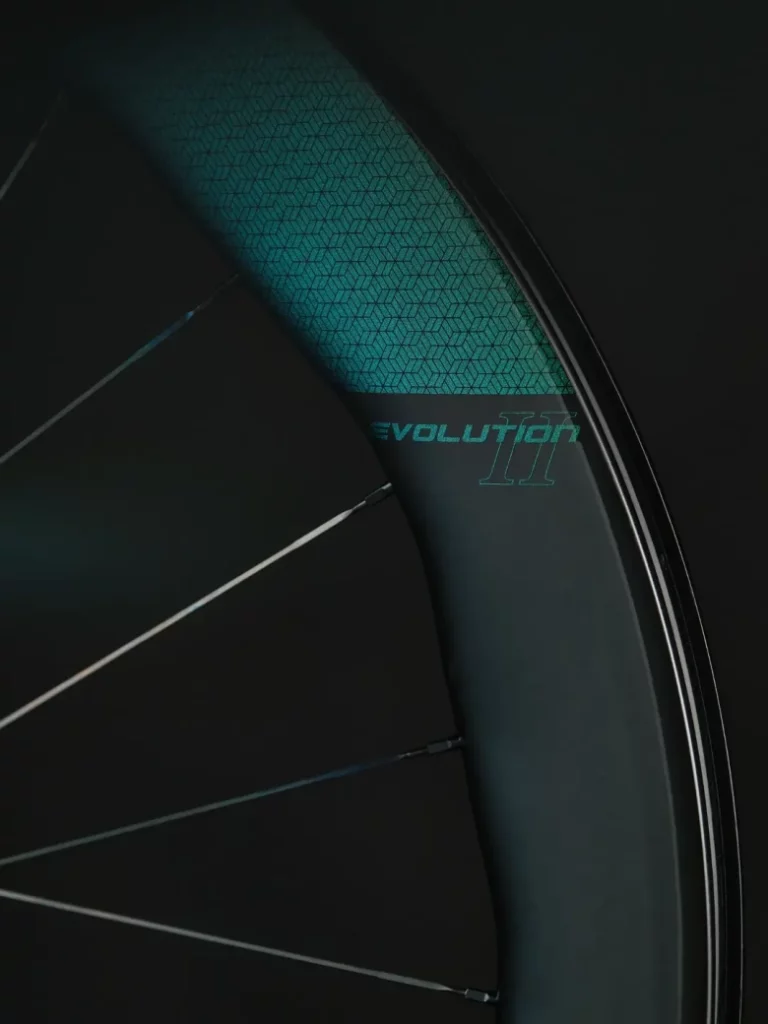
- Founding model: the Wake 6560, launched in 2018 and now in its Evolution II version (2026).
- Results: Filippo Ganna’s time trial world titles in 2020 and 2021, the Hour Record in 2022, Olympic silver in 2024.
- Lawsuit: in February 2023, a Miami jury found that Princeton wheels do not infringe SRAM’s patents.
Also on Princeton: the Wake 6560 Evolution II in detail
The history of Princeton CarbonWorks: rowers who wanted to go faster
Marty Crotty, from the eight to triathlon
To understand Princeton CarbonWorks, you have to understand Marty Crotty. A rower at Princeton from 1994 to 1998, he won national collegiate titles, in the freshman eight in 1995 and then in 1996 and 1998. He only got on a bike the week after the 2000 US Olympic Trials, after a disappointing race, to get some distance from rowing. Turning to coaching, he led the US under-19 national team in 2005, then Princeton’s men’s lightweight squad.
Alongside that, Crotty took up age-group triathlon seriously. He qualified three years in a row for the Ironman 70.3 World Championships, and it was in Las Vegas, in 2011, that he realised he needed better equipment. His brother ran a carbon boat company: the idea of having wheels made with rowing know-how was born.
May 2013: the founding, a rowers’ affair
Crotty turned to Brad Werntz, whom he had selected in 2005 for the Junior World Championships and who had become a Princeton-trained engineer. Werntz brought in Harrison Macris, a former Boston University rower, engineer and SolidWorks design specialist. In spring 2013, after several all-nighters, the co-founders had their concept: a variable-depth rim with a sinusoidal shape.
In May 2013, Marty Crotty, Brad Werntz and Jack Leonard, former captain of Princeton’s lightweight team, officially founded Princeton CarbonWorks. Harrison Macris became its CEO. Richard Furchtgott, another rower who came through Princeton, later joined the team as director of operations.
Paul Daniels, a world champion rower and eight-time member of the US national team, joined the venture. In 2018, the press described him as co-founder and chief operating officer. He was an employee until 2019, and the company now disputes that he was a co-founder.
The philosophy: escaping the three-depth compromise
In a 2018 interview with element.ly, Paul Daniels summed up the logic the brand wanted to break. Big brands offer three rim depths: shallow to climb, mid to cover distance with control, deep to go fast. A practical approach, but in his view a “convenient compromise”, summed up by the phrase “light, stable, fast: pick two”. Harrison Macris and Brad Werntz, coming from outside cycling, instead looked for a single wheel that ticked all three boxes, and sought speed outside the bike world, in aerospace tools.
2015 to 2018: from the first prototype to the Wake 6560
The first rideable prototype was ready in autumn 2015, and Crotty tested it during his winter break, in December. More than 18 months of checks followed, with a simple rule: release nothing that would later force a step backwards. The Wake 6560 reached the market in early 2018, after four years of work claimed by these “uber-nerds” from Princeton and Boston University, as they described themselves.
Princeton CarbonWorks’ innovations: when the sine wave meets carbon
The sinusoidal rim
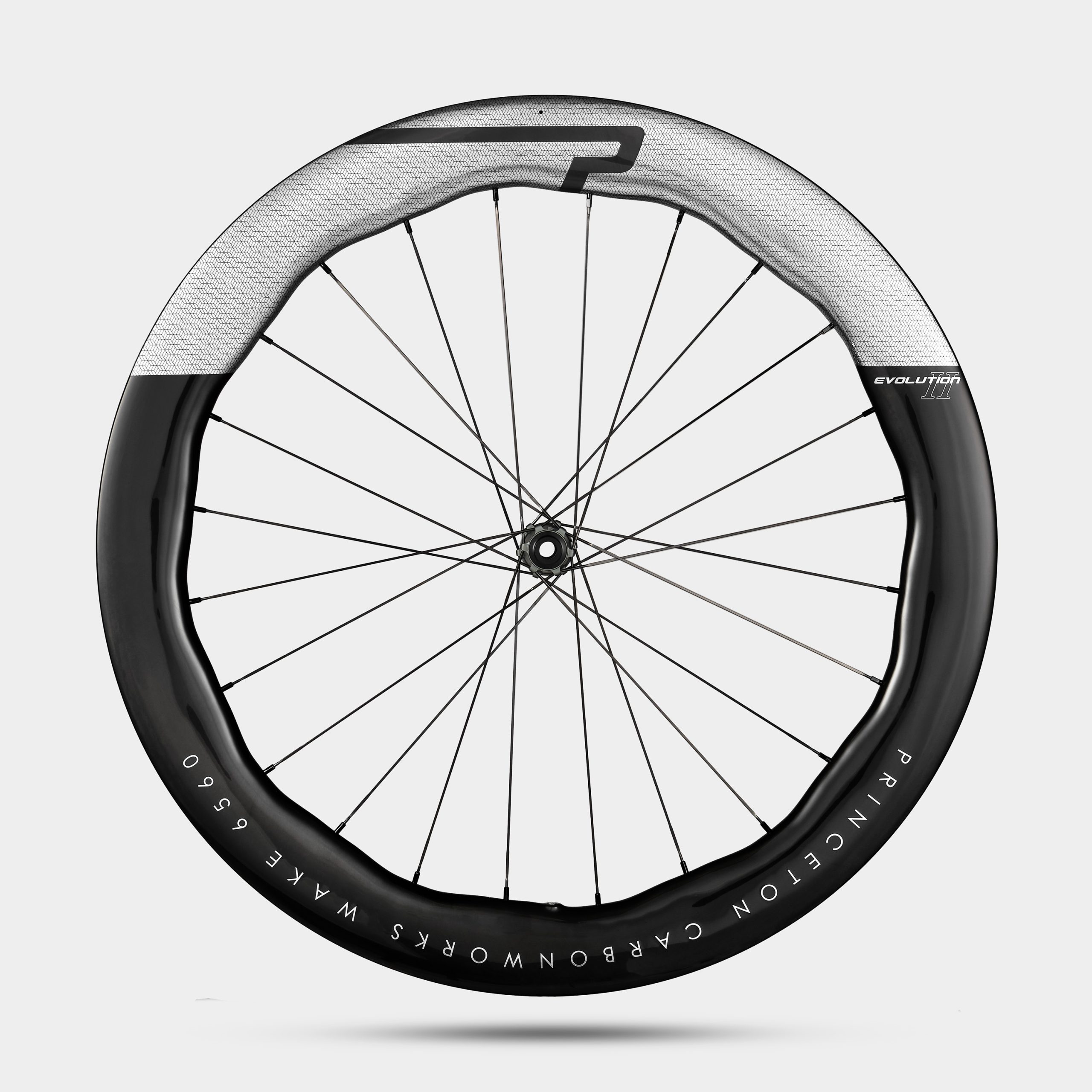
The core idea fits in one word: sine wave. The rim of the Wake 6560 does not keep a constant depth; it oscillates between 60 and 65 mm over 24 undulations. Hence its name: 65 and 60.
On the aerodynamic side, the goal stated by Marty Crotty is to reduce vortex shedding along the rim. The promise: combine the aerodynamic efficiency of a deep rim with the crosswind stability of a shallower one. Development relies on numerical simulation, CFD, then on the wind tunnel.
On the structural side, each spoke is anchored at the peak of an undulation. According to the brand, this layout makes it possible to remove carbon without losing stiffness. Crotty even recalls that, from the very first prototypes, the team found the rims “incredibly strong and stiff”.
An undrilled rim bed and hooks by choice
Princeton rims have no spoke holes in the rim bed. Direct consequences:
- Simpler tubeless: no rim tape to fit, the rim itself is airtight.
- Continuous structure: the brand links this solid rim bed to a stronger rim, as on the Dual 5550.
- Careful build: Sapim CX-Ray spokes and Sapim Secure Lock nipples since the very first Wake 6560.
Another contrarian choice: Princeton sticks with hooked rims while part of the high end moves to hookless. On the Wake 6560 Evolution II, Harrison Macris justifies this by the wish to control the tyre’s shape precisely, since it is the tyre and rim together that meet the air. The hook also allows riding with an inner tube or tubeless.
Wind tunnel testing: results to read closely
When it arrived in the UK, Princeton published measurements taken at the A2 Wind Tunnel in North Carolina, against the Zipp 858, 404 and 454 and the HED Jet 9+ and Jet 6+. The brand claimed the lowest overall drag. In detail, its wheels did better between 0 and 5° of yaw, while others took the lead at wider angles, the HED Jet 9+ from 10°. As road.cc pointed out, these are manufacturer figures from a small sample.
For the Wake 6560 Evolution II (2026), the method moved up a level: 23 to 32 mm tyres 3D-scanned on four rim widths, simulation with NablaFlow, then validation at the Politecnico di Milano and at A2.
The SRAM lawsuit: two years of uncertainty
In March 2021, SRAM, Zipp’s parent company, sued Princeton CarbonWorks in a Florida federal court. The Chicago group argued that the Wake 6560’s wavy rim infringed two patents by inventor Dimitrios Katsanis, granted in 2017 and 2020, on which the “humpback whale flipper” profile of the Zipp 454 NSW is based. SRAM sought treble damages for wilful infringement and the destruction of stock. Princeton challenged the validity of these patents in return. Its law firm would later describe it as a “bet-the-company” dispute.
After a two-week trial in Miami, the jury returned its verdict in February 2023: Princeton wheels infringed neither patent, and no damages were due. The question of validity became moot. SRAM asked for a new trial, which a federal judge refused in August 2025, and the appeal to the Federal Circuit was ultimately dropped. The irony of the case: an earlier Mavic patent was among the prior art examined when SRAM’s patents were granted.
Princeton CarbonWorks’ iconic models
Wake 6560 (2018): the wheel that started it all
The Wake 6560 takes its name from the brand’s dual culture: wake, the trail left by a boat, and 65-60, its two rim depths. Conceived as early as 2012, it was announced in 2018 at 1,480 g a pair, with a rim under 490 g and 26 mm external width, for $2,400 to $3,400 depending on braking and hubs. The first hubs were generic models from Taiwanese maker Bitex, soon replaced by White Industries hubs with titanium freehub bodies, with the price cut to $2,200. Hand built in the USA, it was Filippo Ganna’s front wheel for his first world title.
In 2022, the range split in two: the Wake 6560 Corsa kept an 18.5 mm internal width for 23 to 25 mm tyres, while the Wake 6560 Strada moved to 20.5 mm for tyres of 25 mm and up. In February 2026, the Wake 6560 Evolution II moved to 22 mm internal and 33 mm external width, for 28 mm tyres. The rim lost 50 g (420 g against 470 g on the Evolution I) and the pair dropped to 1,250 g with Tactic TR01 V2 hubs.
Blur 633: the time trial disc
The Blur 633 is the brand’s rear disc wheel. Filippo Ganna paired it with the Wake 6560 to win the time trial world title in 2020, then with the Mach 7580 to retain it in 2021.

Grit 4540: the sine wave goes gravel
The Grit 4540 brings the undulation to gravel: 40 to 45 mm profile, 21 mm internal width and reinforced sidewalls. It was already in the range when the brand arrived in the UK, alongside the Wake 6560.
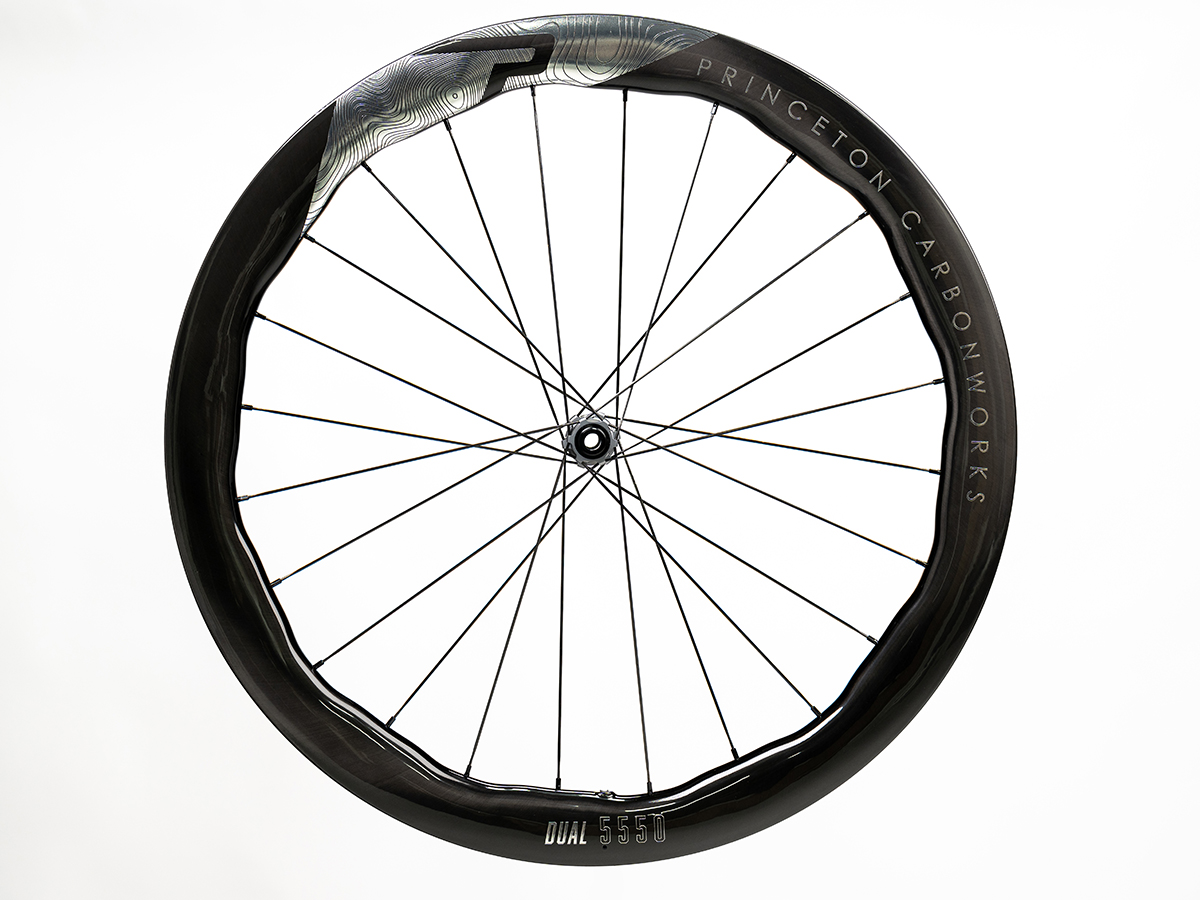
Dual 5550: born for Paris-Roubaix
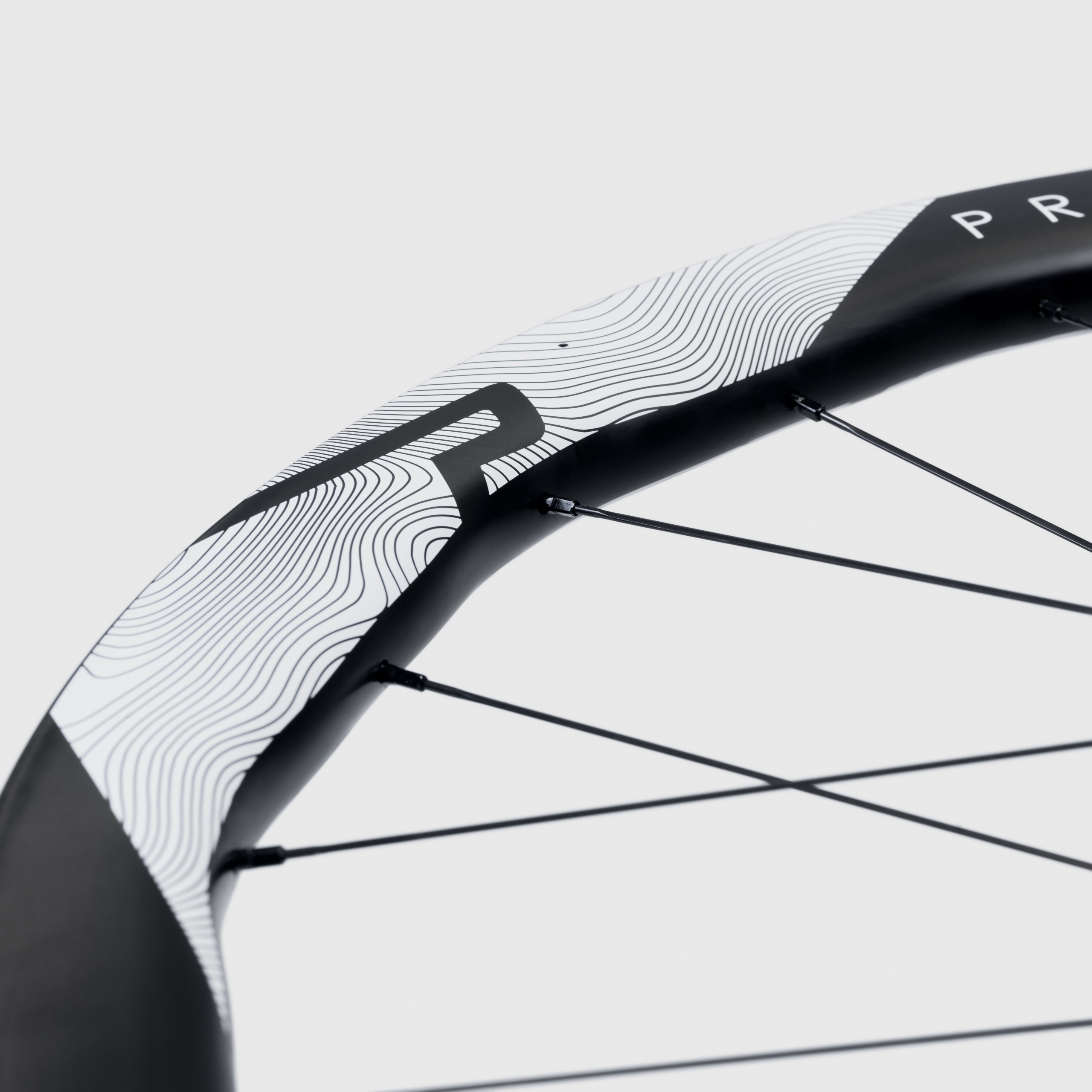
The Dual 5550 came from a brief by Ineos Grenadiers’ mechanics and technical directors: a wheel able to take the cobbles of Paris-Roubaix 2021 without giving up aerodynamics. 50 to 55 mm profile, 22 mm internal width, undrilled hooked rim, 1,440 g a pair, and optimised around 30 to 32 mm tyres. Dylan van Baarle rode this model to second place at the 2021 Road World Championships. The wheel went on sale in early 2022, from $3,000.
Mach 7580: Ganna’s front wheel
With a 75 to 80 mm profile, the Mach 7580 targets time trials and triathlon. Launched in December 2021, it claims 1,495 g in its lightest disc version, with a 19 mm internal width. Before its official launch, completely unmarked versions had already been ridden to world and Olympic podiums in 2021, including the front wheel of Filippo Ganna’s second world title. On the eve of the 2022 Tour de France, Princeton also delivered a tri-spoke front wheel to Ineos, the Mach 7580 TS.

Peak 4550: the climber of the 2021 Tour
The Peak 4550, with a 45 to 50 mm profile, is the light wheel of the range. Ineos Grenadiers adopted it in tubular form at the 2021 Tour de France for the mountain stages, in place of the Lightweight Meilensteins the team had used until then. Princeton had even nicknamed it the “Meilenstein Killer”. Harrison Macris explains that the team’s feedback was used to develop the brake track for big descents. The pair claims 1,071 g in the rim-brake tubular version.
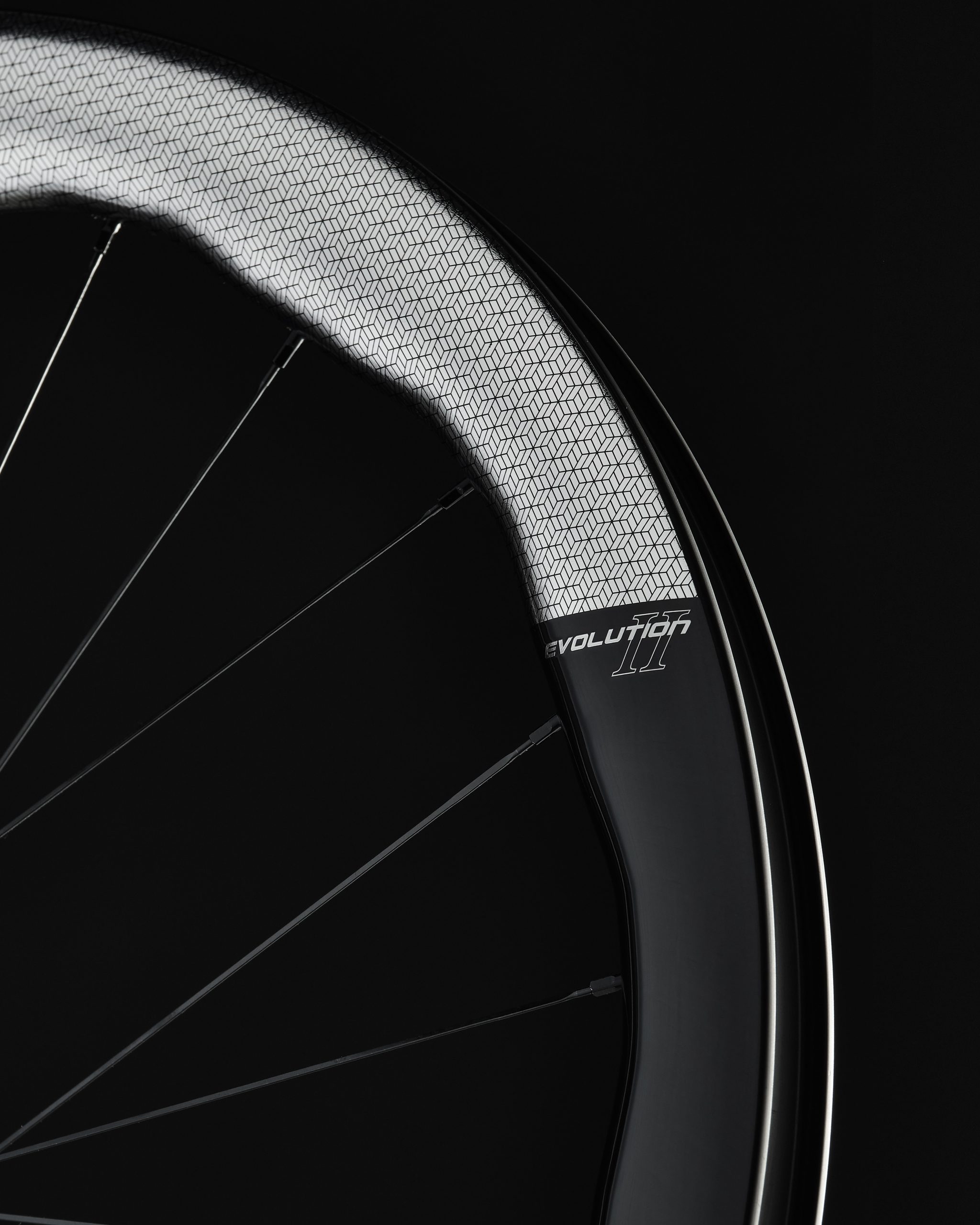
The current range has five families: Wake 6560 Evolution II, Peak 4550 Evolution II, Mach 7580 Evolution, Dual 5550 Evolution and Grit 4540 Evolution.
Results: from Kona to the Hour Record
Theory is good. Proof through racing is better. And Princeton found its way to the WorldTour in a way that suits it: through rowing.
2017 to 2019: Cam Wurf, the gateway to Ineos
In 2017, on the way home from the Head of the Charles, Boston’s big regatta, Marty Crotty watched the Ironman World Championships in Kona. He saw Australian Cameron Wurf, a former Olympic rower, lead the race on the bike with mismatched wheels and no sponsor. That day, Wurf broke the Kona bike course record in 4 h 12 min 54 s, 5 min 29 s faster than Normann Stadler’s 2006 mark. Crotty reached him through the rowing network, notably via Curtis Jordan, his former coach at Princeton. Wurf adopted the wheels and won several Ironman and 70.3 races in 2018 and 2019.
In 2019, Wurf joined the Ineos team. Princeton presented its wheels to the team’s decision-makers in April 2019, and at the 2019 time trial World Championships in Yorkshire, the Wake 6560 was already the front wheel on the bikes of Filippo Ganna, the bronze medallist, Dylan van Baarle and Eddie Dunbar. The logos were hidden: the relationship was still informal.
2020: Imola, the first world title
The 2020 season, pushed back by the pandemic, gave Ineos staff time to test the wheels in depth. The Wake 6560 was fitted to the time trial bikes for stage 20 of the Tour de France. Six days later, on 25 September in Imola, Filippo Ganna became the first Italian time trial world champion, on a Wake 6560 front and a Blur 633 rear.
2021: Ganna’s double and the test of the cobbles
Princeton became a team partner in 2021, according to Dan Bigham, Ineos’ performance engineer. That year, Ganna retained his world title with the Mach 7580 at the front and the Blur 633 at the rear, and the Dual 5550 made its debut on the cobbles of Paris-Roubaix.
2022: the Hour Record
On 19 August 2022, Dan Bigham set a new Hour Record in Grenchen, Switzerland, on Princeton track wheels. On 8 October, on the same track, Filippo Ganna raised it to 56.792 km. For his Pinarello Bolide F HR, Princeton designed especially narrow wheels, matched to hubs that were themselves narrower than standard.
2024: Olympic silver
At the Paris 2024 Olympic Games, Filippo Ganna won the time trial silver medal on Princeton wheels. Speaking to NBC Connecticut, Harrison Macris summed up the brand’s ambition: to make the most cutting-edge parts possible so that the best athletes set world records and win titles. To him, these are “the Ferrari of bike wheels”.
Manufacturing: Mystic, Connecticut
Princeton CarbonWorks works in Mystic, Connecticut, in a former National Guard armoury around 80 years old, tucked away in a residential neighbourhood. A small, highly skilled team builds the wheels there, laced by hand. As for the rims, Bikerumor reported in 2018 that the rim-brake version came from a factory known for making carbon rims for other high-end brands, without being able to name it. Hubs are offered as options, including the in-house Tactic brand, White Industries, Tune, Chris King or DT Swiss 180 depending on model and period, always with Sapim CX-Ray spokes.
For Harrison Macris, the aim is to be “at the cutting edge of aerodynamic design” while optimising stiffness and weight, to make the fastest, most high-end product possible.
Conclusion: Princeton CarbonWorks, rowing rigour applied to the wheel
To understand Princeton CarbonWorks, you have to look beyond the spec sheet. It is a brand born from rowing culture, where every hundredth of a second counts, and from a simple geometric idea taken all the way: a rim that undulates. It survived a lawsuit against SRAM, equipped Filippo Ganna for his world titles and the Hour Record, and keeps making its own choices, such as hooked rims while others go hookless.
More information on the official Princeton CarbonWorks website
Technology summary
| Technology | Main function | Benefit for the rider |
|---|---|---|
| Sinusoidal rim | Variable depth, 24 undulations between 60 and 65 mm on the Wake 6560 | Aims for the efficiency of a deep rim with more crosswind stability |
| Spoke at the peak of the undulation | Each spoke is anchored at a high point of the rim | Less carbon for the same stiffness, according to the brand |
| Undrilled rim bed | No spoke holes in the rim bed | Tubeless without added rim tape |
| Hooked rim | Hooks kept, reinforced on the Evolution II | Controlled tyre shape, inner tube or tubeless |
| Tyre and rim development | 3D tyre scanning, CFD then two wind tunnels (Evolution II) | Aerodynamics optimised for the tyre actually fitted |
Frequently asked questions about Princeton CarbonWorks
Who founded Princeton CarbonWorks?
Princeton CarbonWorks was founded in May 2013 by Marty Crotty, a rowing coach at Princeton, engineer Brad Werntz and Jack Leonard, all three former Princeton rowers. Harrison Macris, a former Boston University rower, joined them and runs the company.
Why are Princeton rims wavy?
The rim depth varies in a sine wave, from 60 to 65 mm on the Wake 6560. The aim is to reduce vortex shedding along the rim to get the efficiency of a deep wheel with more crosswind stability. Each spoke is anchored at the peak of an undulation.
Are Princeton CarbonWorks wheels tubeless?
Yes. The rim bed is not drilled, so there is no tubeless tape to fit. The rims keep their hooks, which also allows riding with an inner tube.
Did Princeton copy the Zipp 454 NSW?
Not according to the US courts. In February 2023, after a two-week trial in Miami, a jury found that Princeton wheels infringed neither of the two patents asserted by SRAM, and that no damages were due.
Which riders have won on Princeton wheels?
Filippo Ganna won the 2020 and 2021 time trial world titles and broke the Hour Record in 2022 (56.792 km) on Princeton wheels, before taking Olympic time trial silver in Paris in 2024. Triathlete Cameron Wurf won several Ironman and 70.3 races on these wheels in 2018 and 2019.