
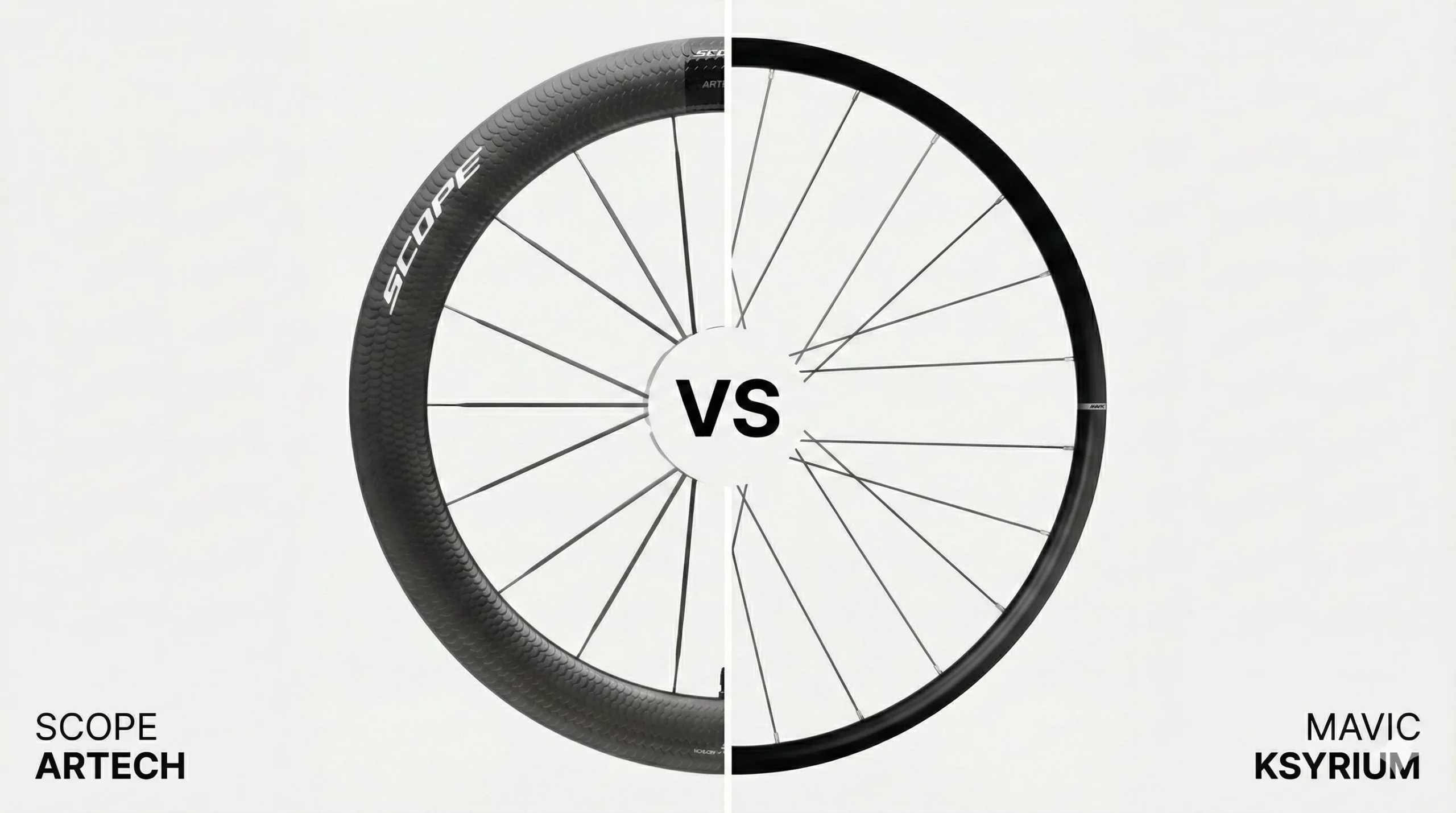
Wheel Comparer: the reality behind marketing promises
We all know the song. A big brand releases a new pair of wheels at 2800€ and promise you « 12 watts save at 45 km/h » or « 10 minutes won on the Tour Stage ». You look at your current wheels with disdain, you take out the blue card, and the following Sunday... surprise: you don't fly, you just have the lighter wallet.
The problem is that these tests are carried out in wind tunnel, often without a cyclist, or at speeds (50 km/h) that 99% of us only hold in a pass descent. Marketing sells dreams, physics imposes its reality.
To stop fantasizing about advertising brochures, I developed this Single wheel comparison. It crosses my wheel database with real physical models to give you, not a promise, but a reliable order of magnitude.
Your performance simulator
Select your favorite collar, your data and compare different types of wheels.
Wheel Comparer
If you played honestly with the tool, you must have had a shock. Between a pair of basic aluminum wheels and a premium carbon pair at 3000€, the gap on a collar climb often counts in... seconds. Not in minutes. And on the flat, at 30 km/h average, the gain is barely noticeable.
The limiting factor is you (80%)
Let's be clear: on the flat, about 80% of the total aerodynamic resistance comes from the man on the bike. Wheels represent only a fraction of the remaining 20% (bike).
Conclusion: Changing a 30mm rim for a 50mm without working your position (closed maillot, bent elbows) amounts to putting a Formula 1 wing on a Twingo. It's marginal.
If watts don't count that much, how do you choose?
That's my point. My tool is not used to tell you « Don't buy anything ». It's for you freeing from dictatorship performance. Since the simulator proves you won't be « dumped » with your current wheels, you no longer have to buy « fastest » on paper. You can finally buy the one that gives you the smile for the True good reason.
Are ceramic bearings really worth the cost?
It's probably the biggest marketing lie of the century. The friction difference between a clean steel bearing and a ceramic is in the order of 0.5 watt... at 50 km/h. On the other hand, poorly maintained ceramics quickly damage. Keep your money for good tires.
What saving of real time hope with aero wheels?
According to my simulator and field tests: for a cyclist riding at 30 km/h average alone facing the wind, the gain is about 40 to 60 seconds by 40km flat compared to basic wheels. It's measurable, but it won't turn a race donkey into a race horse.
Is the weight of the wheels important uphill?
Yeah, but less than we think. Winning 200g on the wheels will save you about 5 to 10 seconds on a climb from one hour to 8%. The feeling of vivacity will be better, but the chronometer will remain ruthless.
To go further
Now you have the clear ideas on the wheels. But did you know that adjusting your tire pressure has far more impact on your performance and comfort than your rim material? A super carbon wheel badly swollen is an avil. Use my other tools to optimize your machine.
Leave a comment