
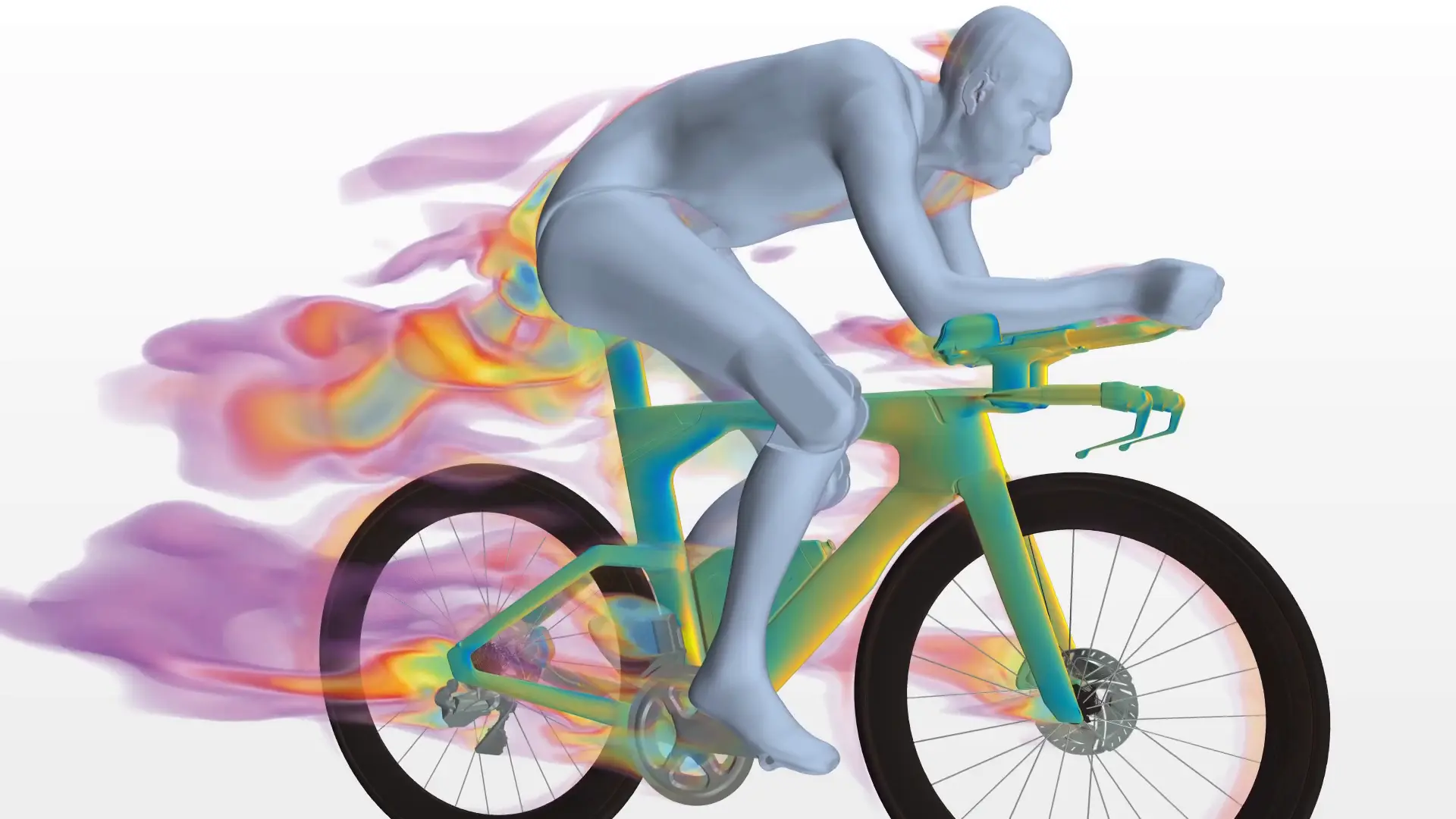
CFD explains: how the computer designs your bike wheels
If you have recently consulted high-end wheel data sheets such as those of Zipp, DT Swiss, Swiss Side or the latest aerodynamic frames, you have inevitably come across a mysterious acronym: CFD. Often used as a guarantee of scientific quality and absolute performance, this term remains obscure for most cyclists. Is it simply marketing or a real technological revolution?
Modern cycling is no longer just about weight. It is played against an invisible but omnipresent enemy: air. At 30 km/h, more than 80% of your energy is used only to push the air molecules in front of you. To overcome this resistance, engineers no longer sculpt matter by hand; They use supercomputers to simulate millions of possible scenarios.
In this case, we will dive into the heart of the matrix. We will understand how the CFD transformed the design of the material, killed the rims in the shape of « V » the 2000s and allowed the emergence of large tires. Welcome to the era of the virtual wind tunnel.
What's CFD? Definition and principle
The acronym CFD means Computational Fluid Dynamicsor in French: Digital Fluid Mechanics. To make it simple, it's a virtual wind tunnel that runs inside a very powerful computer.
Imagine you wanted to test the air penetration of a new carbon rim. Instead of making a costly mould prototype, cooking it, sanding it and taking it to a physical wind tunnel across the country, you create a 3D model on your computer. Next, CFD software will cut the space around this wheel into millions of small cubes (that's what we call the mesh or « mesh »).
The software will then apply complex physical laws, including equations of Ship-Stokes. These equations, dating back to the 19th century, describe the movement of fluids (gas or liquids). They are so complex that it is impossible to solve them perfectly by hand for complicated forms. This is where the computing power comes in: the computer solves these equations for each small cube of the mesh, calculating the pressure, speed and direction of the air at each millimetre of the wheel.
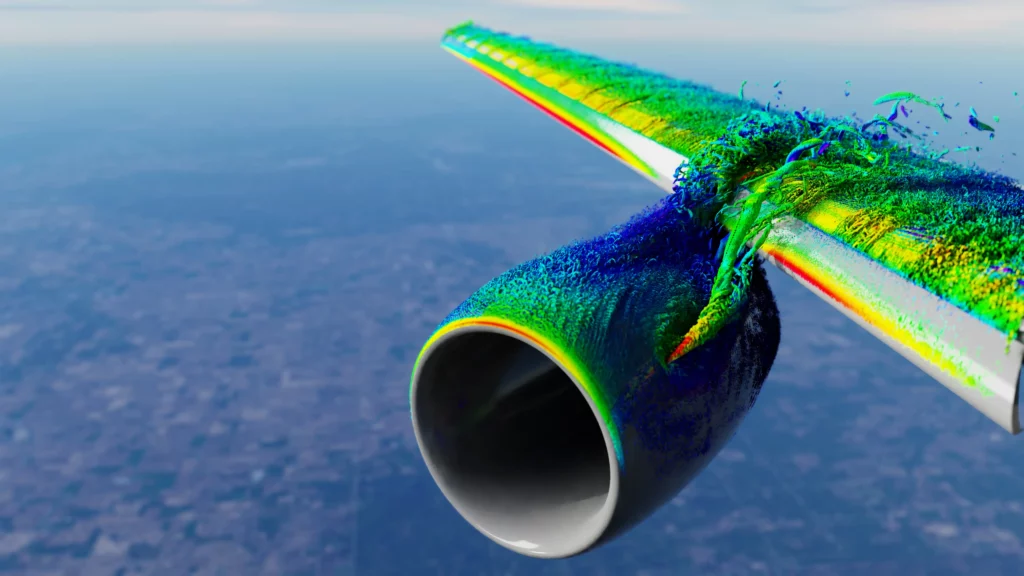 CFD is used in many fields such as aviation.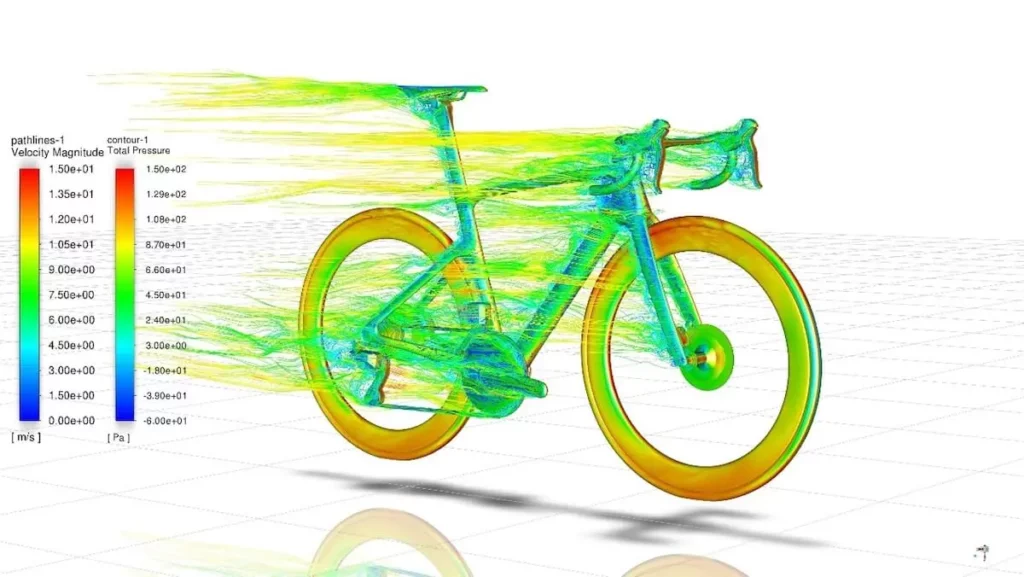
Why use CFD to design wheels?
The cycle industry, and particularly the wheel industry, has turned massively towards the CFD in the last fifteen years. This is why this technology has become unavoidable, sometimes exceeding the intuition of designers.
1. The speed of iteration
That's the number one advantage. In traditional methods, designing, manufacturing and testing a prototype takes weeks or even months. With the CFD, an engineer can test 100 variations in curvature of a rim in a single day. It can change the rim width by 1 millimetre, restart the calculation and see the result the next morning. This allows us to explore radical paths without risking a manufacturing budget.
2. See invisible
In a real wind tunnel, smoke is used to visualize air flows. It's pretty, but it only shows what's going on « around » of the object. CFD lets you see « everywhere ». The engineer can visualize high pressure zones (in red) that brake the cyclist, or areas of depression (in blue) at the rear that act as a suction cup (the drag).
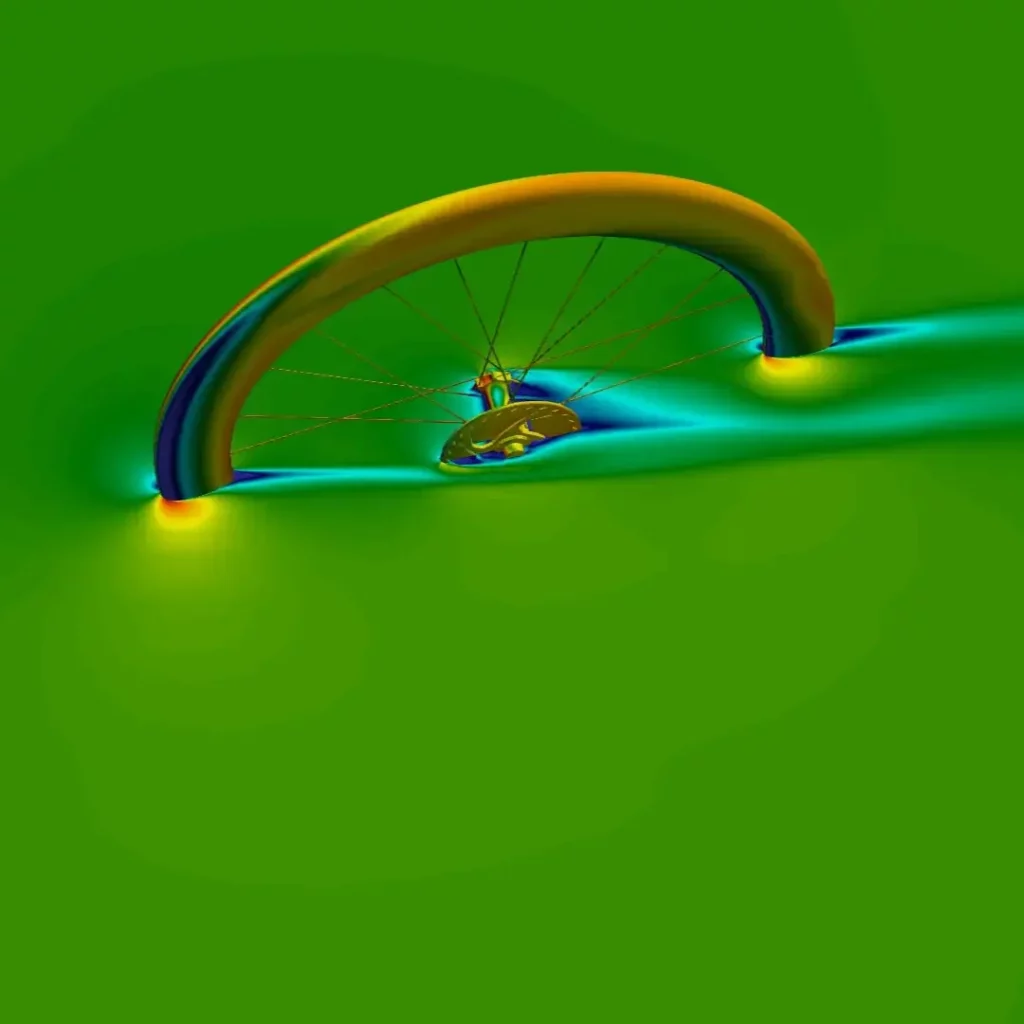
More importantly, the CFD makes it possible to visualize the turbulence and the detachment of the boundary layer (the moment when the air no longer reaches « paste » on the rim surface). Understanding where and why air is picking up is the key to designing a wheel that remains stable by side wind.
3. Optimize tyre to rim torque
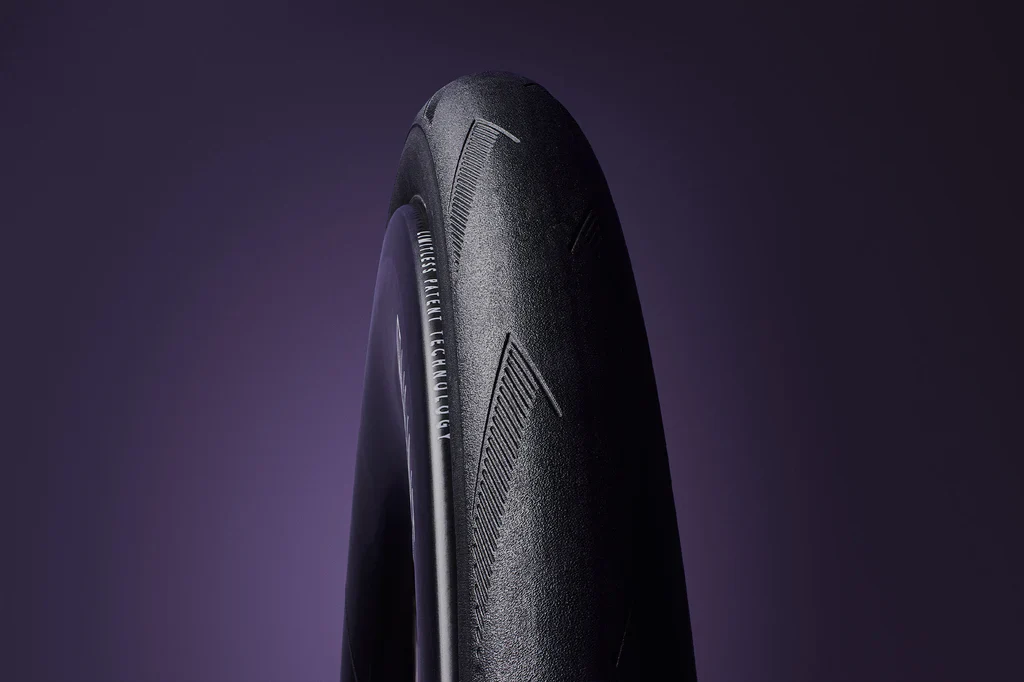
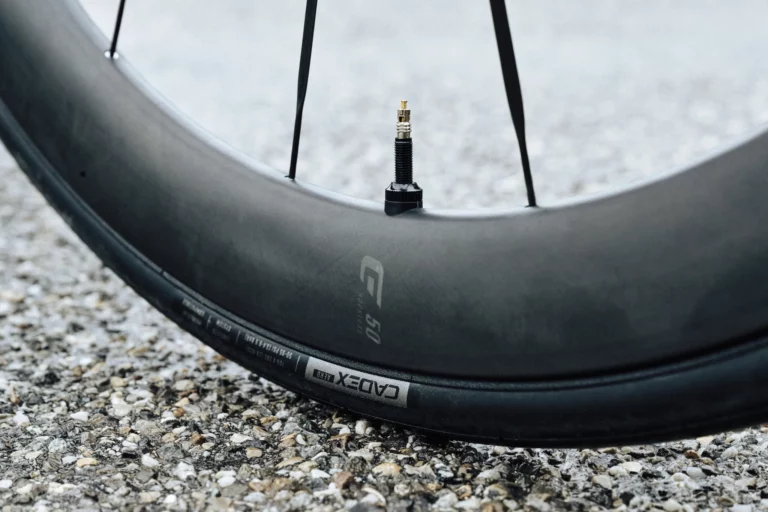
A wheel never runs alone; It is paved with a tire. For a long time, wheel manufacturers did not know the impact of the tire. The CFD revealed that the transition between the sidewall of the tire and the rim is critical. If the tire forms a « bulb » (lightbulb effect) because it is too wide for the rim, it disturbs the air flow even before it touches the rim. Thanks to the CFD, the brands realized that it was necessary to extend the rims to align the walls with modern tires of 25mm or 28mm.
CFD vs Real Breath: The Game
If the CFD is so powerful, why do brands like Swiss Side or Specialized continue to spend fortunes to rent wind tunnels? The answer is simple: CFD is a design tool, wind tunnel is a validation tool.
| Characteristics | CFD (Simulation) | Breathing (Real) |
|---|---|---|
| Cost | Software investment + hardware | Very high (rent per hour) |
| Flexibility | Infinite (you can change everything) | Limited to physical prototypes available |
| Conditions | Ideal or complex (depending on setting) | Real but controlled |
| Accuracy | Depends on the quality of the mesh | Absolute reference (if strict protocol) |
The limits of the simulation: « Garbage in, Garbage out »
Information technology « Garbage in, Garbage out » (if you come in from the garbage, it comes out of the garbage) applies perfectly to the CFD. If the engineer misconfigures the initial parameters (for example, if he does not simulate wheel rotation or ground roughness), the results will be false. This is why independent experts such as Hambini often criticize brands that publish CFD charts that are too smooth or unrealistic.
Furthermore, simulating a bike is extremely complex because it is an object « Unprofiled » (bluff body) with moving parts (legs, pedals, rays). Simulating air instability (transitional simulation) requires a phenomenal computing power that few brands have. This is why final validation in the wind tunnel remains essential to verify that the computer has not been mistaken.
In concrete terms, what has changed on our bikes with the CFD?
The impact of the CFD is visible to the naked eye if you compare a 2010 wheel and a 2024 wheel. Here is the major evolution dictated by the algorithms:
The death of « V-Shape » and the birth of « U-Shape »
At the beginning of the aero, intuition dictated to make pointed rims, in the shape of V, for « cut » Air. The CFD proved it was a mistake for a bike. Why? Because, unlike an aircraft, a bike experiences lateral winds (the yaw angle).
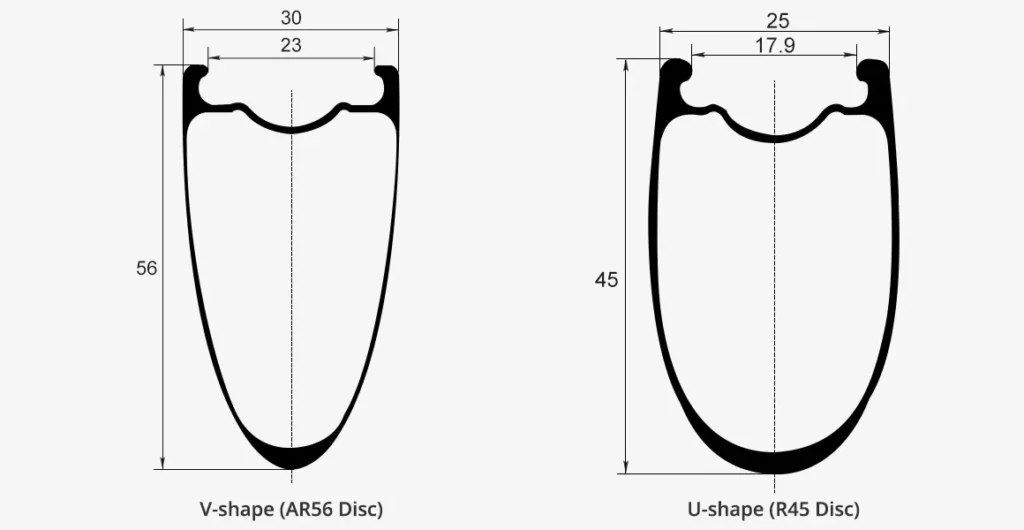
Simulations have shown that when the wind comes from the side, a V rim causes a sudden stall of the air, making the bike unstable and increasing the drag. On the other hand, the CFD has made it possible to draw up profiles of U (or toroidal), with a rounded nose. This form allows air to « bypass » The rim without getting off, even with a crosswind. As a result, you go faster, and above all, you no longer get caught up in the gusts.
Who best controls this technology?
All brands claim to use CFD, but the level of expertise varies greatly. Some subcontract basics, while others have aerospace or Formula 1 engineers.
| Make / Actor | Origin of expertise | Specific approach |
|---|---|---|
| Swiss Side | Formula 1 (Sauber F1) | Absolute pioneers. They use F1 (pressure wave) methods to correlate CFD with reality. They also design for DT Swiss. |
| Zipp (SRAM) | Biomimetics | Use CFD to develop complex shapes such as profile « Sawtooth » (saw teeth) inspired by humpback whales. |
| Hambini | Aerospace Engineering | Independent engineer known to denounce bad practices and use CFD to analyze transient turbulence. |
| POC | Security & Science | Use the CFD not only for aero, but also to scan the positions of cyclists (Digital Twins) and optimize safety. |
| Ku Cycle | Triathlon | Focus on the interaction between the fork and front wheel to minimize the high front pressure area. |
| Hunt | Science | The English wheel brand has made the CFD its specialty to design the best aero wheels at a reduced price. |
Conclusion: Is the CFD magic?
The CFD has undoubtedly brought cycling equipment into a new age of maturity. It has made it clear that aerodynamics is not just about « Split air » to manage complex, unstable and lateral flows. Thanks to it, we drive today with wider, more comfortable tires, while being faster than with ultra-fine hoses ten years ago.
However, digital simulation remains a tool. It does not replace the field test. As Jean-Paul Ballard of Swiss Side often points out, nothing is equal to « truth of the road ». The CFD makes it possible to trim 95% of the work, but it is the last 5%, validated in windmill and bitumen, that make the difference between a good wheel and a legendary wheel.


Leave a comment