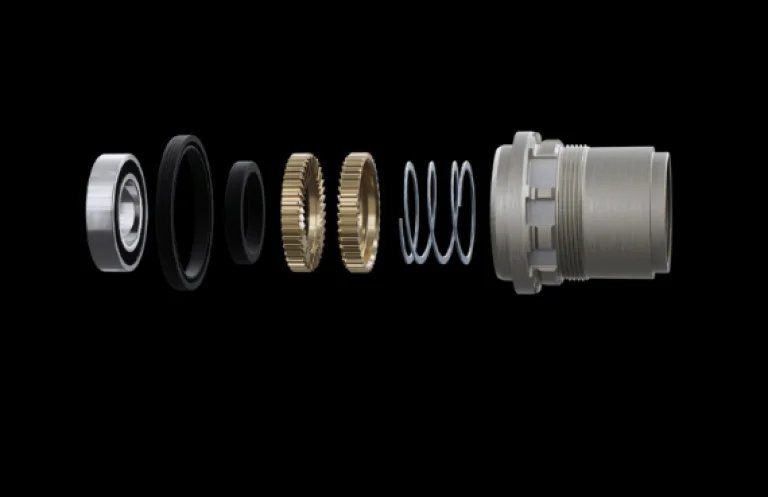
Instant Drive 360 (ID360) – Mavic
The freewheel body is the mechanism that transmits pedaling effort from the cyclist to the rear wheel. Mavic has developed its own system, called Instant Drive 360 (ID360), which now equips all of its road range from Ksyrium S to Cosmic Ultimate 45. This ratchet mechanism demands rapid engagement, reduced friction and simplified maintenance. Here is its detailed operation.
What is the Instant Drive 360?
The mechanism
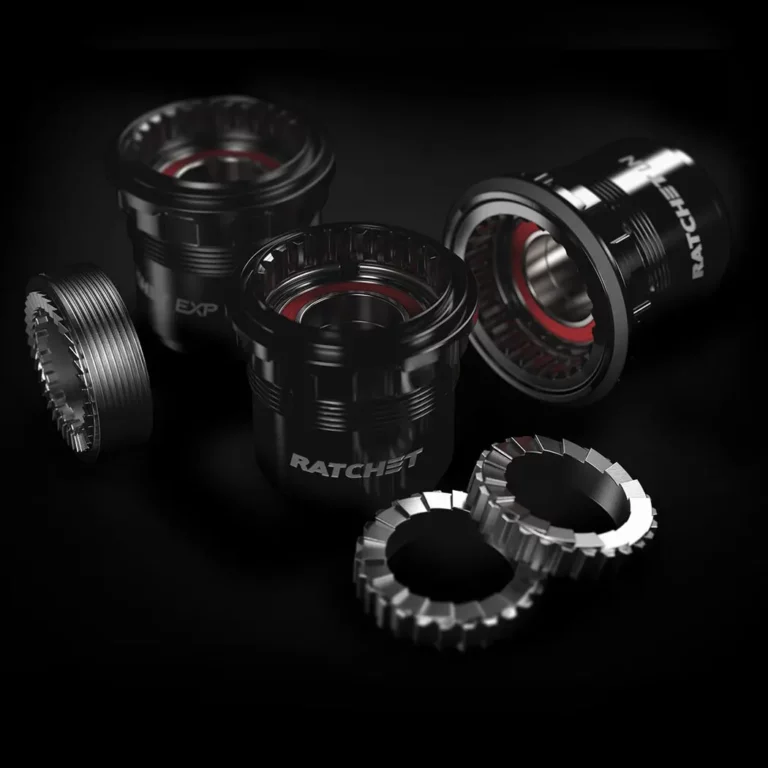
It is a free-wheel system with a ratchet. It uses 40 engagement points, which corresponds to a 9° engagement angle. Specifically, when the cyclist presses the pedals after a freewheel phase, the wheel responds after only 9° of rotation, a fast engagement, although other competing systems (such as DT Swiss's Ratchet EXP, 36 points) offer comparable or higher values.
Low friction joint
A contactless oversized rubber seal is included in the product. This seal does not exert any mechanical pressure on the rotating parts, thus reducing friction to its minimum. The result is a free wheel that runs more freely in the free wheel phase (descent, release of pedals).
Compatibility
It comes standard with a Shimano/SRAM HG freewheel body. Optional freewheel bodies are available for Campagnolo cassettes (ED11 and N3W) and SRAM XD-R. Body change is done without tools, in seconds.
Reliability
Mavic states that the ID360 has been tested in extreme conditions, mud, snow, cold, sand, and that it equips more than 100,000 wheels produced to date.
The concrete benefits of ID360
1. Rapid commitment to recovery
The 40 engagement points (9°) allow an almost instant transmission of the stress. At the end of the turn, when re-launching after a slowdown or attack, the time between the pedal stroke and the wheel response is reduced. This is a perceptible advantage in racing and on hilly routes.
2. Freewheel brake
The contactless seal eliminates the parasitic friction in the freewheel phase. This friction reduction is particularly sensitive during descent or recovery phases, where the wheel rotates freely for long periods.
3. Quick and toolless maintenance
Disassembly of the freewheel body for cleaning or replacement is done by hand, without any specific tool. This is a notable practical advantage over certain competing systems that require special keys or a workshop visit.
4. Compatibility versatility
The availability of interchangeable bodies (Shimano HG, Campagnolo, SRAM XD-R) makes the Mavic wheels compatible with almost all market groups, which facilitates a possible change of transmission without changing wheels.
On which wheels do we find the ID360?
The D360 is deployed throughout the Mavic road range:
- Cosmic Ultimate 45 Disc – high-end carbon
- Cosmic SLR – carbon performance with ceramic bearings
- Cosmic SL 40 and Cosmic SL 65 – mid-range carbon
- Cosmic S 42 Disc – carbon entry range
- Ksyrium SL and Ksyrium S (skating and disc versions) – aluminium range
- Ksyrium Heritage SL – new 2025/2026
It is also present on the gravel ranges (Allroad) and MTB (Crossmax, Deemax) by Mavic.
Conclusion
It is the common denominator of all current Mavic wheels. With its 40 engagement points, contactless joint and toolless maintenance, it is a competitive and well-designed freewheel system for everyday use. It is not distinguished by a record engagement angle (some competitors fall to 5° or less), but it offers a good compromise between responsiveness, reliability and ease of maintenance. For cyclists who value the simplicity of maintenance and the versatility of compatibility with different cassettes, this is a strong argument.